How Much of Your Socializing Is Actually Worth It?
I’ve always found socializing—talking with people, exchanging ideas, keeping conversations going—to be genuinely interesting. Because of that, I’ve spent a great deal of time on it over the past few years.
But in the last six months or so, I’ve started asking myself a few uncomfortable questions: Why am I socializing in the first place? Why does it take up so much of my time? And how much of it is actually valuable?
What counts as “ineffective socializing”?
One definition I once came across describes ineffective socializing as:
Social activities that bring no pleasure or improvement to your mind, emotions, work, or life.
That sounds neat, but it also feels too formal—and not quite accurate. Any social interaction affects us in some way, positively or negatively. Whether that effect helps us grow, leaves no trace, or quietly drains us is not always easy to measure.
It is a bit like when someone says, “Playing games and reading novels are a waste of time.” But while immersed in games or fiction, you may be expanding your imagination. Isn’t that a kind of benefit too? 🐶
To me, socializing is essentially a process of exchanging information. If, during that exchange, one person brings the other a new way of thinking, or helps solve a real problem, then I would call it effective socializing. Put simply, effective socializing creates additional value. That increase may be large or small, but something new is produced.
Since the rise of the internet, the range of people and information we can reach has expanded enormously. We receive far more feedback than before. Once the amount of information reaches a certain level, we have to spend a lot of time listening, reading, replying, and interacting in other ways. Ineffective socializing often hides inside this process.
To see where it tends to appear, we can roughly divide online social interaction into a few types:
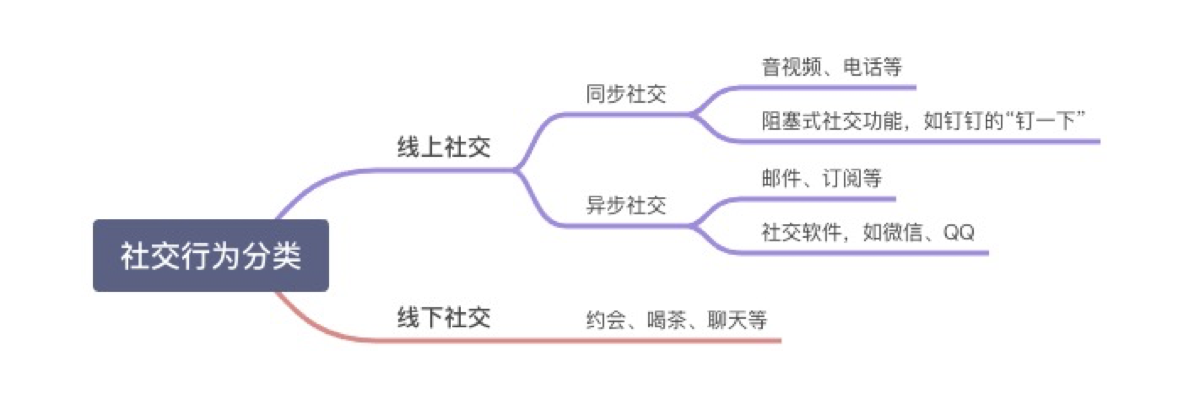
Online communication can be blocking or asynchronous. Phone calls, video calls, or features that “nudge” someone usually require us to stop whatever we are doing and respond right away. WeChat messages and emails, on the other hand, can usually be read and answered later. Social interaction can also be divided by the number of participants: one-to-one, one-to-many, many-to-many, and so on.
Everyday social behavior is extremely varied. Here are a few familiar scenes:
- You sit in a noisy chat group, watch people talk nonsense, throw in a few comments yourself, and somehow end up getting drawn into the discussion.
- You see someone who seems impressive, so you go over, exchange pleasantries, and try to become a familiar face.
- You vent a little on your social feed, receive a bunch of likes and replies, and then continue chatting with people in the comments.
- You see someone on Zhihu making what you think is a childish argument, and you rush in, full of righteous energy, to debate—or fight—with them.
- During the New Year, you write one greeting and send it to every friend you know, and even some people you barely know.
- …
It is worth noting that none of these examples is automatically “ineffective socializing.” The key question is how you judge them.
Everyone has a ruler in their own mind for measuring value. What feels meaningful to you may feel pointless to someone else, and the reverse is also true. So ineffective socializing begins with first defining the scale of that internal ruler. Any interaction that falls below your own threshold of value is ineffective socializing for you.
You can take that ruler and measure the scenes above against it. You will quickly discover what counts as ineffective socializing in your own life. Yes, this sounds a little utilitarian. But you have to be clear about one thing: if ineffective socializing consumes a large amount of your time, then the time left for doing real work, learning, resting, or creating will naturally become smaller and smaller.
Raising the quality of your social life
Self-discipline can reduce some ineffective socializing. You can stop hanging around noisy groups, complain less, avoid becoming a keyboard warrior, and limit contact with people in general.
But if you do that too rigidly, you may also become rather boring. Worse, you may lose many opportunities for high-quality interaction that would otherwise have been valuable. So the question is not simply “How do I socialize less?” but “How do I socialize better?”
First, you need to think clearly about why you want to socialize.
Are you hoping to get help from someone? Are you trying to get closer to someone you like? Do you want to expand your circle? Or are you trying to become a better conversationalist?
Social interaction can be active or passive. In most interactions, both sides occupy one of these roles.
- If you are the one initiating the interaction, you should ask yourself: What problem do I hope this person can help me solve? Are they actually able to help? Are they willing to help?
- If you are the one being approached, you should ask yourself: Can I help this person? Do I need to help them? Will this lead to further interaction that continues afterward?
Again, this way of thinking is somewhat utilitarian. But it makes your social behavior more purposeful. If you keep “mutual benefit” in mind, your interactions are more likely to become effective and meaningful.
Next, consider what kind of social interaction is most efficient.
We often see situations like these:
- Two people exchange pleasantries for ages, drift off topic, spend half the conversation talking about old stories, and just as they are about to get to the real issue, the other person says they need to go have lunch.
- You run into a problem and ask A. A tells you to ask B. B sends you to C. You go in a circle, and in the end, you still have to solve the problem yourself.
Getting straight to the core issue is an art. It reveals a person’s ability to abstract, analyze, and identify what matters. Effective socializing requires filtering out noise so both sides can reach common ground as quickly as possible. It also requires clear judgment: you need to see the relationships between people and problems, and find the most suitable person to talk to.
It is also worth leaving a good opening for the next interaction.
Human favors are powerful. If you help me today, I may help you tomorrow. When people help one another, the things they hope to accomplish become easier and more efficient. In itself, that is something that benefits society.
Let the right conversations remain
If you want better social interaction, you can gradually replace the people you spend time communicating with. Let negative voices, pessimistic figures, and low-quality information appear less often in your field of vision. Over time, the quality of your social life will naturally improve.
Follow your own judgment. Socialize sincerely, kindly, and harmoniously. That is often how better social connections begin.