PPAP Explained: Requirements, Submission Levels, Run at Rate, and Customer Approval
PPAP, short for Production Part Approval Process, is one of the core tools used in the IATF 16949 / QS-9000 quality framework.
At its simplest, PPAP is how a supplier proves to a customer that it can consistently manufacture a part that meets requirements under real production conditions.
That distinction matters. PPAP is not just a test report, and it is not simply a record that one batch passed inspection. It is evidence that a part, made with a specific production setup—tooling, equipment, operators, methods, and process parameters—can continue to meet engineering and quality requirements in stable mass production.
PPAP is about process capability, not one-time conformity
A common misunderstanding in manufacturing is: if the supplier performs 100% inspection before shipment and the customer accepts the goods, doesn’t that already prove quality?
Not really.
A part passing inspection today does not prove that the same process will still produce conforming parts tomorrow, next week, or next month. PPAP exists to close that gap.
Once a part is approved through PPAP, the customer is no longer relying only on shipment-by-shipment detection. The customer is placing trust in the supplier’s ability to repeatedly produce compliant parts without waiting for problems to appear first.
Here is the practical difference:
<table> <thead> <tr> <th>Situation</th> <th>Without PPAP</th> <th>With PPAP</th> </tr> </thead> <tbody> <tr> <td>Problems in the first incoming lot</td> <td>Often discovered only after field or customer complaints</td> <td>More likely to surface during trial production and PPAP validation</td> </tr> <tr> <td>Process variation</td> <td>Controlled mainly by inspectors catching defects</td> <td>Quantified and managed with SPC and Cpk</td> </tr> <tr> <td>Process changes</td> <td>May happen informally</td> <td>Changes require notification and often PPAP resubmission</td> </tr> <tr> <td>Customer confidence</td> <td>Each batch is treated cautiously</td> <td>Confidence is placed in the approved process capability</td> </tr> <tr> <td>Cost of quality</td> <td>High after-sales cost and claims</td> <td>More effort upfront for long-term stability</td> </tr> </tbody> </table>The five PPAP submission levels
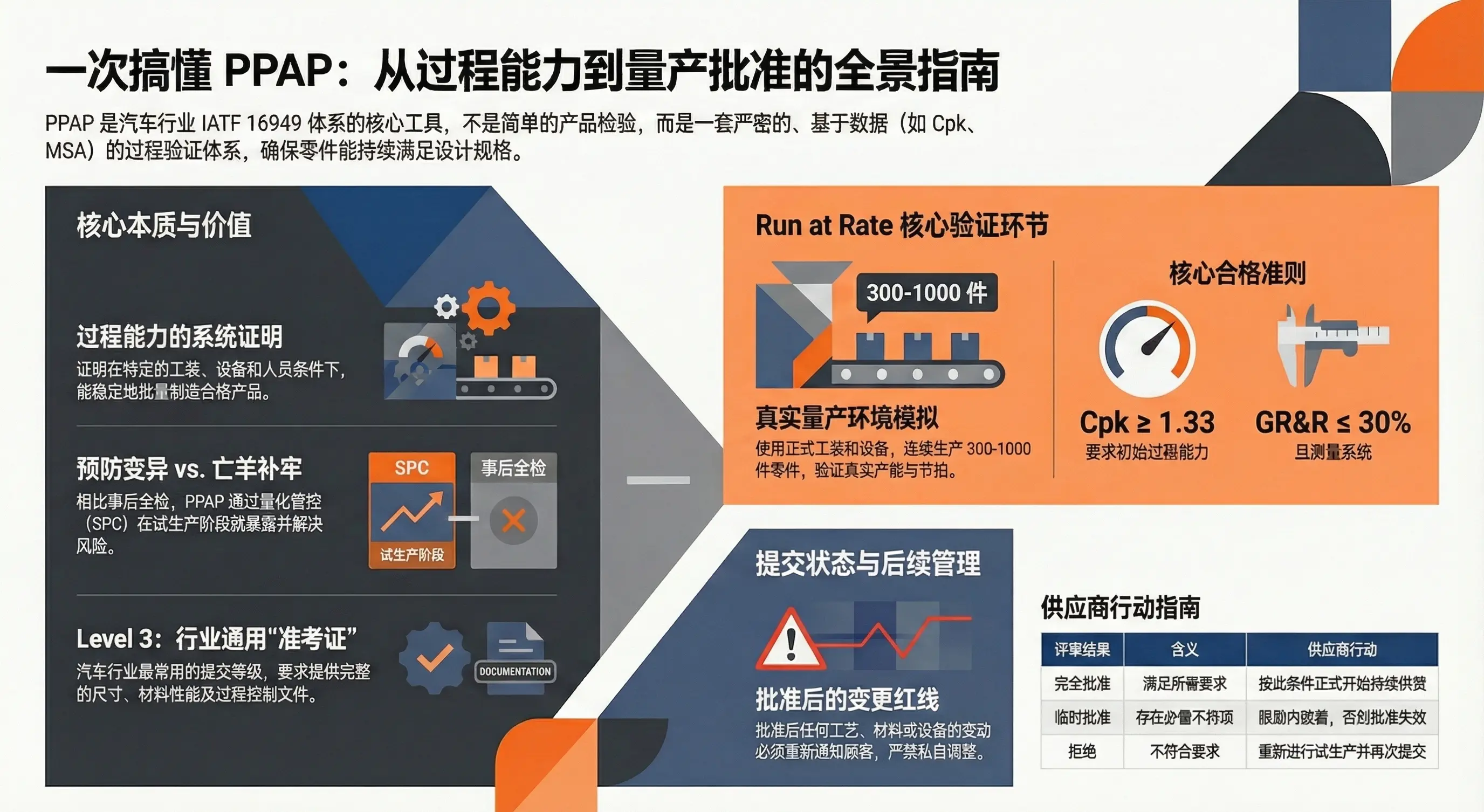
PPAP does not always require the same amount of documentation. There are five submission levels, and the higher the level, the more evidence must be provided.
<table> <thead> <tr> <th>Level</th> <th>Typical submission content</th> <th>Common use</th> </tr> </thead> <tbody> <tr> <td>Level 1</td> <td>Appearance Approval Report (AAR), if required</td> <td>Simple internal parts</td> </tr> <tr> <td>Level 2</td> <td>Sample parts + AAR + dimensional results</td> <td>Common in lighter cases</td> </tr> <tr> <td>Level 3</td> <td>Sample parts + appearance report + dimensional results + material/performance test results</td> <td>Most common in automotive</td> </tr> <tr> <td>Level 4</td> <td>Sample parts + other customer-defined requirements</td> <td>Rarely used</td> </tr> <tr> <td>Level 5</td> <td>Sample parts + full supporting documentation + process parameter records</td> <td>Design freeze or long-term programs</td> </tr> </tbody> </table>In automotive supply chains, Level 3 is the most common expectation and is widely used by vehicle manufacturers.
The 18 core PPAP deliverables
A PPAP package is not a single form. It is a structured set of records that together show design intent, process risk control, measurement reliability, production capability, and trial production performance.
1) Design and engineering change documents
<table> <thead> <tr> <th>No.</th> <th>Deliverable</th> <th>Purpose</th> </tr> </thead> <tbody> <tr> <td>1</td> <td>Design Records</td> <td>Product drawings, specifications, approved revision and date</td> </tr> <tr> <td>2</td> <td>Authorized Engineering Change Documents</td> <td>Any approved engineering changes issued after the original design record</td> </tr> </tbody> </table>2) Design and process analysis inputs
<table> <thead> <tr> <th>No.</th> <th>Deliverable</th> <th>Purpose</th> </tr> </thead> <tbody> <tr> <td>3</td> <td>DFMEA</td> <td>Design Failure Mode and Effects Analysis, typically applicable to OEM-designed parts</td> </tr> <tr> <td>4</td> <td>Process Flow Diagram</td> <td>Maps the manufacturing flow from raw material to finished product</td> </tr> </tbody> </table>3) Design and process verification documents
<table> <thead> <tr> <th>No.</th> <th>Deliverable</th> <th>Purpose</th> </tr> </thead> <tbody> <tr> <td>5</td> <td>DFMEA</td> <td>Reviewed and signed by the responsible approval team</td> </tr> <tr> <td>6</td> <td>PFMEA</td> <td>Process Failure Mode and Effects Analysis</td> </tr> <tr> <td>7</td> <td>Control Plan</td> <td>Defines control points, methods, and inspection frequency</td> </tr> <tr> <td>8</td> <td>Measurement System Analysis (MSA)</td> <td>GR&R evidence showing repeatability and reproducibility of the measurement system</td> </tr> <tr> <td>9</td> <td>Initial Process Capability Study</td> <td>Cp/Cpk evidence, with Cpk typically required to be at least 1.33</td> </tr> </tbody> </table>4) Samples and test results
<table> <thead> <tr> <th>No.</th> <th>Deliverable</th> <th>Purpose</th> </tr> </thead> <tbody> <tr> <td>10</td> <td>Sample Parts</td> <td>Parts made with normal production tooling, equipment, and operators</td> </tr> <tr> <td>11</td> <td>Dimensional Results</td> <td>Measured dimensional inspection results against drawing and control plan requirements</td> </tr> <tr> <td>12</td> <td>Material / Performance Test Results</td> <td>Reports for chemical, physical, and mechanical properties</td> </tr> </tbody> </table>5) Production validation records
<table> <thead> <tr> <th>No.</th> <th>Deliverable</th> <th>Purpose</th> </tr> </thead> <tbody> <tr> <td>13</td> <td>Production Part Approval</td> <td>Formal production part approval documentation</td> </tr> <tr> <td>14</td> <td>Quality History</td> <td>Historical supply quality performance, such as PPM or return rate</td> </tr> <tr> <td>15</td> <td>Trial Production Run Results</td> <td>Results from the Run at Rate activity</td> </tr> </tbody> </table>6) Supplemental records
<table> <thead> <tr> <th>No.</th> <th>Deliverable</th> <th>Purpose</th> </tr> </thead> <tbody> <tr> <td>16</td> <td>Control Plan Feedback</td> <td>Customer confirmation of the control plan</td> </tr> <tr> <td>17</td> <td>Bulk Material Requirements</td> <td>Applicable for raw material or bulk material suppliers</td> </tr> <tr> <td>18</td> <td>Laboratory Documentation</td> <td>Accreditation or qualification evidence for internal or third-party labs</td> </tr> </tbody> </table>The four possible PPAP decisions
After submission, the customer usually responds with one of four approval statuses.
<table> <thead> <tr> <th>Status</th> <th>Meaning</th> <th>What the supplier should do</th> </tr> </thead> <tbody> <tr> <td>Full Approval</td> <td>PPAP fully meets customer requirements</td> <td>Supply can proceed under the approved conditions</td> </tr> <tr> <td>Provisional Approval</td> <td>Mostly acceptable, but some issues remain</td> <td>Correct them within the allowed timeframe or the approval may lapse</td> </tr> <tr> <td>Rejected</td> <td>Submission does not meet requirements</td> <td>Trial production and PPAP must be redone and resubmitted</td> </tr> <tr> <td>Interim / Waiver</td> <td>Customer allows supply under specific temporary conditions</td> <td>Requires clear written agreement and defined responsibility boundaries</td> </tr> </tbody> </table>Temporary approval is often misunderstood. Some suppliers treat it as a green light to start shipping and fix the issues later. That is risky. If the required actions are not closed by the deadline, the customer may force a complete PPAP resubmission, and in serious cases supply status can be affected.
Where PPAP sits inside APQP
PPAP does not stand alone. It is embedded in Phase 4 of APQP: Product and Process Validation.
<table> <thead> <tr> <th>APQP Phase</th> <th>Name</th> <th>Relationship to PPAP</th> </tr> </thead> <tbody> <tr> <td>Phase 1</td> <td>Planning</td> <td>Customer-specific requirements are identified, including PPAP expectations</td> </tr> <tr> <td>Phase 2</td> <td>Product Design and Development</td> <td>DFMEA identifies key product characteristics that affect PPAP acceptance</td> </tr> <tr> <td>Phase 3</td> <td>Process Design and Development</td> <td>PFMEA, Control Plan, MSA, and Cpk evidence are prepared for PPAP</td> </tr> <tr> <td>Phase 4</td> <td>Product and Process Validation</td> <td>PPAP is submitted and approved here</td> </tr> <tr> <td>Phase 5</td> <td>Production and Continuous Improvement</td> <td>Stable production continues under PPAP-approved conditions, with SPC monitoring</td> </tr> </tbody> </table>A typical Phase 4 flow looks like this:
- Start Phase 4
- Conduct trial production / Run at Rate
- Produce 300 to 1000 consecutive parts, depending on customer requirements
- Perform MSA, with GR&R below 30%, and ideally below 10%
- Perform initial capability study, with Cpk ≥ 1.33, and key characteristics often requiring ≥ 1.67
- Complete dimensional and performance validation
- Assemble the 18 PPAP elements
- Submit the package to the customer
- Customer reviews and gives one of three practical outcomes:
- Full approval → move to Phase 5 mass production
- Temporary approval → improve within deadline
- Rejection → return to Phase 4 and repeat the validation cycle
Run at Rate: the core practical check in PPAP
Among all PPAP activities, Run at Rate is the most important hands-on verification step.
It means the supplier must use real mass-production tooling, actual production equipment, normal operators, and the intended production process to run a continuous build and prove both output capacity and quality capability under true manufacturing conditions.
Typical Run at Rate requirements
<table> <thead> <tr> <th>Item</th> <th>Typical requirement</th> </tr> </thead> <tbody> <tr> <td>Production quantity</td> <td>300–1000 parts, depending on customer requirements</td> </tr> <tr> <td>Production conditions</td> <td>Official production tooling + production equipment + production operators</td> </tr> <tr> <td>Production pace</td> <td>Must meet target cycle time, usually within ±10%</td> </tr> <tr> <td>Yield requirement</td> <td>Must satisfy the required AQL, often around 0.10–0.65</td> </tr> <tr> <td>Recordkeeping</td> <td>Output, scrap, and equipment/process parameters must be recorded throughout</td> </tr> </tbody> </table>Typical pass criteria
A Run at Rate is generally considered successful only if all of the following are demonstrated:
- Required quantity of conforming parts is produced
- Cpk ≥ 1.33, and key characteristics ≥ 1.67
- GR&R ≤ 30%
- Dimensional inspection acceptance is 100% within specification
- No major quality abnormality occurs, especially not on safety or regulatory characteristics
What happens if Run at Rate fails?
The expected response is structured, not improvised:
- Stop production immediately and isolate suspect product
- Launch a cross-functional root cause analysis, using methods such as 5 Why or fishbone analysis
- Implement corrective actions, which may include engineering changes, process parameter adjustments, or equipment repair
- Update the PFMEA and Control Plan
- Repeat the Run at Rate
- Resubmit PPAP
What a real Level 3 PPAP package usually looks like
A practical Level 3 PPAP file set for an automotive component is often organized roughly like this:
- 1. Design Records
- Approved 2D / 3D drawings
- Technical specifications
- 2. Engineering Change Documents
- ECO list and related change records
- 3. Engineering Approval
- DVP&R or design verification records
- 4. DFMEA
- Reviewed and signed design FMEA
- 5. Process Flow Diagram
- Flow chart with key operations identified
- 6. PFMEA
- Reviewed and signed process FMEA, with high-risk items closed
- 7. Control Plan
- Pre-launch control plan approved by the customer
- 8. Measurement System Analysis
- GR&R report showing results below 30%
- Gauge calibration certificates
- 9. Initial Process Capability Study
- Cpk calculations, often based on X-bar/R chart data
- Capability analysis showing Cpk ≥ 1.33
- 10. Sample Production Parts
- Typically 3 to 5 production-made samples with labels
- 11. Dimensional Results
- Full layout dimensional report
- CMM report when applicable
- 12. Material / Performance Test Results
- Chemical composition reports
- Mechanical property reports such as tensile or impact results
- Any customer-specific special test reports
- 13. Production Part Approval Form
- Completed in the customer-required PPAP form format
- 14. Quality History
- Recent incoming quality or PPM / yield trend data
- 15. Trial Production Run Results
- Run at Rate record sheets
- Output and scrap records
- Equipment and process parameter logs
- 16. Control Plan Feedback
- Customer confirmation or approval record
- 17. Bulk Material Requirements
- Raw material inspection specification, if applicable
- 18. Laboratory Documentation
- ISO 17025 accreditation certificate or internal lab qualification records
What the customer actually reviews in a PPAP package
Customer review is usually focused on five areas.
1. Document completeness
- Were all required PPAP elements submitted?
- Are signatures, dates, and revision levels complete?
- Do the forms match the customer’s required format?
2. Conformance to engineering requirements
- Are all measured dimensions within tolerance?
- Do material and performance results meet the specification?
- Are special or key product characteristics backed by complete validation data?
3. Evidence of process capability
- Is the Cpk data credible and properly generated?
- Does the MSA show the measurement system is reliable?
- Is the SPC evidence stable and authentic, rather than backfilled later?
4. Consistency between PFMEA and Control Plan
- Are the risks identified in PFMEA reflected in actual control methods?
- Are high-risk items, such as D > 9 or RPN > 65, addressed with clear elimination or reduction actions?
5. Authenticity of Run at Rate records
- Were equipment parameters stable?
- Was the required output achieved?
- Is nonconforming product handling documented clearly?
PPAP approval is not the finish line
Getting PPAP approved does not end the supplier’s responsibility. In practice, it marks the point where the approved process becomes the baseline for controlled mass production.
<table> <thead> <tr> <th>After approval</th> <th>Supplier responsibility</th> </tr> </thead> <tbody> <tr> <td>Stable production</td> <td>Produce strictly according to the approved process conditions and control plan</td> </tr> <tr> <td>Change management</td> <td>Notify the customer of any change in process, equipment, material, or tooling; resubmission may be required</td> </tr> <tr> <td>SPC monitoring</td> <td>Continue statistical monitoring during mass production and react quickly to abnormal trends</td> </tr> <tr> <td>Annual PPAP update</td> <td>Some customers require annual PPAP renewal or periodic resubmission</td> </tr> <tr> <td>Issue escalation</td> <td>Communicate abnormalities to the customer quality engineer without delay</td> </tr> <tr> <td>Continuous improvement</td> <td>Use production data and customer feedback to improve process capability over time</td> </tr> </tbody> </table>One of the most dangerous mistakes in PPAP management happens after approval. Some suppliers loosen control, change parameters freely, switch materials without notice, or reduce inspection frequency because the part has already been approved. That behavior defeats the purpose of PPAP. If a quality issue later occurs, the customer can trace the deviation back to the approved PPAP baseline, and the consequences can be severe.
Common PPAP questions in practice
Does mass production require customer PPAP approval first?
In automotive practice, yes. Formal supply is not supposed to begin without PPAP approval unless the customer has issued a written Interim or Waiver.
How many parts should be built during trial production?
A common range is 300 to 1000 pieces, but the exact quantity is customer-defined. The important point is that production must be continuous and representative of real capacity.
What if Cpk is below 1.33?
The process capability must be improved before PPAP submission. If the characteristic is safety-related or regulatory, the requirement is typically stricter, often Cpk ≥ 1.67.
Can PPAP proceed if GR&R is above 30%?
Generally no. A measurement system with GR&R > 30% is unacceptable. The MSA must be improved first—through better gauges, operator training, improved fixturing, or other corrective action—before capability data can be trusted.
What if the customer asks for Level 3 but internal resources are limited?
Level 3 is standard practice in many automotive programs. Reducing the submission effort may look easier in the short term, but it often leads to greater after-sales risk, claims, and hidden quality cost later.
Can a supplier’s own laboratory perform PPAP testing?
Yes, but the lab should have ISO 17025 accreditation or be able to provide acceptable internal laboratory qualification records. Test data from unqualified labs is often rejected.
What if the part is mainly appearance-based and has no traditional dimensional report?
An Appearance Approval Report (AAR) may be required according to customer rules, but other applicable items—such as material and performance evidence—still have to be submitted as required.
How is Run at Rate handled for low-volume, high-mix production?
This usually needs alignment with the customer quality engineer. In some cases, PPAP can be submitted by part family, or one representative part may be selected for each category.
The real value of PPAP
PPAP is not an administrative ritual for satisfying a customer checklist. Its real value is that it turns supplier quality capability into a structured, reviewable body of evidence.
From the customer’s side, PPAP builds confidence in supplied parts and reduces incoming inspection burden and field risk.
From the supplier’s side, it forces a disciplined review of process readiness, exposes hidden weaknesses early, and creates a formal basis for change control.
For both sides, it creates a mechanism for long-term stability rather than short-term firefighting.
The logic is straightforward:
- If APQP Phase 3 is done well,
- then Run at Rate tends to go smoothly,
- which makes the PPAP package complete and credible,
- which leads to full customer approval,
- which supports stable Phase 5 production,
- and then continuous improvement can push capability even further.
PPAP is only the visible result. Process capability is the real foundation.