Why Some Software Teams Move Slowly: The Hidden Patterns That Kill Development Efficiency

People often talk about development efficiency in abstract terms, but in software teams the real problems are usually concrete, visible, and repeatable. Once you have seen enough teams operate, certain patterns show up again and again. They look normal on the surface—specialization, process, coordination, support roles, more tools, more oversight—but in practice they drag delivery down, multiply communication costs, and steadily weaken engineering quality.
This is not about business efficiency or product decision-making. It is specifically about efficiency in software development and software engineering.
Several common development patterns deserve close attention: lock-heavy development, relay-style development, nanny-style development, WatchDog-style development, and failure-driven development. These are not edge cases. They are common ways teams become slow without realizing why.
Locks inside software development
Anyone who has worked with concurrent programming understands what a lock is: something used for synchronization and mutual exclusion. Many development organizations accidentally build the same thing into their team structure.
One common form is a skill lock. A project needs work across multiple areas and technologies—Java, C/C++, Python, JavaScript—but each developer only knows one language. As a result, the team has to coordinate constantly. Tasks have to be scheduled around specific individuals. Dependencies pile up. What could have been done by two people in three weeks turns into eight people working for two months.
Another form is a module ownership lock. Different people each own different modules. A project touches many modules, so all of those owners must be pulled in. Every person already has their own priorities and timeline. The more people involved, the more locks appear. Something that should have taken two people two weeks becomes seven or eight people spending more than a month.
These are not theoretical problems. They lead directly to several kinds of friction:
- Time and schedule locks: when people have different skills or control different modules, work waits for availability. Coordination becomes scheduling overhead.
- Communication and interest locks: people spend large amounts of time arguing about where a feature should be implemented, who should own it, and whose priorities matter most. That creates buck-passing, bureaucracy, and internal politics.
Division of labor is often treated as if it automatically creates efficiency. In reality, it is frequently abused. Teams use “specialization” as an excuse to only ever do one narrow thing.
What helps
A programmer should be able to work across multiple languages, handle multiple modules, and even take on different responsibilities when necessary. If learning another language or understanding another module feels impossible, that is not a healthy sign. Teams become faster when engineers are broad enough to reduce dependency locks.
Relay-style software development
Once a team accumulates enough of these locks, it almost inevitably falls into relay-style development.
The lower-level C programmer finishes and hands work to the Java programmer. Then it gets handed to the frontend engineer. Then it goes to operations. Work moves like a baton in a relay race.
This becomes much worse when process layers are added on top. A downstream team spends a month building something, then QA spends a month testing it, then operations spends a month rolling it out in stages. After that, the upstream team finally gets the API from the downstream team, develops for another month, then hands it to its own QA for a month, then to its own operations team for another month. Half a year disappears. It is essentially a large waterfall built from many smaller waterfalls.
A common response is that upstream and downstream teams can agree on interfaces in advance and develop in parallel. That is one valid optimization, but it depends on strong interface design. In practice, two problems show up repeatedly:
- If the upstream and downstream teams are not closely working together, the later team often waits until the earlier team is ready for testing before it really starts. So-called parallel development becomes serial development.
- When there are more teams in the chain—A -> B -> C -> D—interfaces become critical. But if there are no strong interface designers, the interfaces keep changing during development, or teams are forced to live with interfaces that are awkward and harmful.
What helps
Instead of handoff-heavy development, the supporting teams should reverse the model. If the application team is Team A, then Teams B, C, and D should package their work as frameworks, platforms, services, or standardized capabilities that the application team can integrate on its own.
Frontend teams can build frontend frameworks. Operations or production engineering teams can build deployment and operational tooling. Shared module teams can offer reusable engineering frameworks. The application team then connects to those capabilities directly rather than waiting for another team to do the work for them.
The cost of many teams negotiating ad hoc interfaces pair by pair often ends up being far higher than the cost of defining a unified standard.
Nanny-style software development
Nanny-style development is when developers only “eat the meal” and expect someone else to cook and clean up. It is common in the relationship between development and QA, or development and operations. In many organizations, testing and operations become babysitters for developers.
A typical example: developers quickly write code and barely test it before sending it to QA. QA begins testing and finds all kinds of problems. If QA mainly does black-box testing, it may not be able to tell immediately whether the issue comes from code or from the environment, so even more time is spent ruling out environmental causes before a bug can be reported back. Many of those issues could have been caught earlier through code review or unit tests, yet they were pushed downstream.
Operations often suffers the same pattern. Software gets built with little thought for deployability, observability, or maintenance. Because an ops team exists, developers assume they do not need to think about operational concerns themselves.
This works like parenting: the more parents do everything for a child, the more the child assumes that is normal, and the less capable the child becomes.
Nanny-style development often evolves into guard-style development:
- If developers are weak in design, weak in engineering practice, and do not do code review or unit testing, then a large QA team is assigned to watch them.
- If development and QA focus only on features and ignore operations, then a larger operations team is assigned to watch them too.
- If technical staff do not understand the business or requirements, then a BA or product manager is added to direct them.
- If they cannot manage projects well, then a project manager, agile coach, or SQA role is added to manage the managers.
The result is layers upon layers of supervision. If one group is not trusted, another group is added to watch it; if that group is not enough, yet another group is added to watch the watchers. Headcount keeps growing, meetings consume the calendar, people spend their days explaining themselves and arguing with one another, and the number of people who contribute process noise rises faster than the number of people who build software.
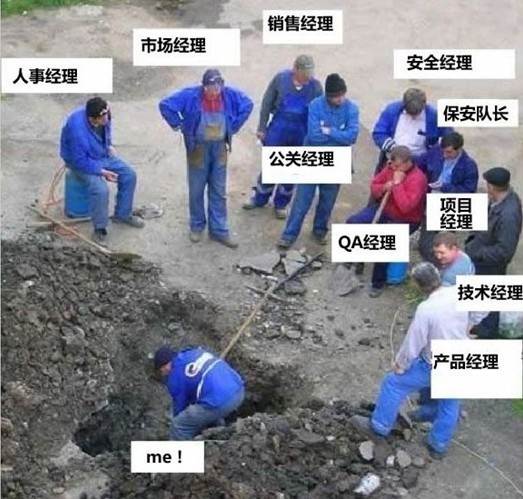
What helps
-
Hire engineers, not people who only know how to write code. Teams need people who understand requirements, software engineering, software quality, and maintainability.
-
The best management is not more people managing more people. The strongest teams are able to manage themselves.
-
Keep support-heavy roles to a minimum. The fewer purely supervisory or compensatory layers, the better.
-
Think in terms of service, not babysitting. Serving another team does not mean doing its work for it. It means making that team more capable and more efficient.
Operations is a good example. If an internal operations team builds tools that let application teams easily request machines, storage, networking, middleware, and security resources—and just as easily deploy, manage, and monitor their applications—while also providing operational guidance, then operations is creating leverage rather than cleaning up after developers. That kind of thinking naturally moves toward an internal cloud platform.
WatchDog-style software development
A WatchDog-style pattern appears when a team responds to one problematic system by building another system to watch it.
Examples are everywhere:
- The architecture is too complicated, and problems are hard to diagnose. So a special monitoring system is added.
- Configuration is too complicated and easy to get wrong. So a configuration validation system is added.
- Configuration and real production state can drift apart. So an inspection or consistency-checking system is added.
- Test and production environments sometimes get mixed up. So another permission-control system is added for production.
- There is a single point of failure, so a load balancer is added. Then the load balancer itself becomes a single point of failure, so another equivalent routing layer is added.
Adding more pieces is easy. Simplifying a system is harder, and that is exactly why teams avoid it.
When design was never thought through properly before launch, and the system has already gone live, redesign becomes politically and operationally difficult. Then every problem gets “fixed” by another patch, another layer, another tool, another exception. It is like a flawed building that cannot be torn down and rebuilt, so everyone keeps patching the cracks forever.
What helps
- Think through design before implementation. Evaluate multiple design options. Simplify, simplify, simplify.
- Pay back technical debt ruthlessly. Debt repayment should not be optional or endlessly postponed.
Failure-driven software development
WatchDog-style development is often produced by failure-driven development.
This is the mentality of launching first and fixing later: get it online, and deal with problems after they happen.
Leadership or business stakeholders may say that perfection is unnecessary at the start, that the system only needs to satisfy immediate business demand, and that refactoring or improvement can happen later. Some technical people also use the idea that “architecture evolves” to justify this pattern.
Iteration and architectural evolution are real and important ideas. But they are also frequently abused as excuses by people with limited ability, shallow fundamentals, or weak discipline.
Iteration does not mean carelessness. Evolution does not mean launching without rigor. Diagnosing a production failure can require enormous effort. A sloppy local shortcut may feel fast in the moment, but taken as a whole it makes the organization slower.
Yes, systems often improve after one outage after another. But that does not prove the approach is sound. Serious systems are not built by stacking accidents and emergency fixes. Improvement through failure happens, but it is a costly and unnecessary way to learn lessons that should have shaped the design from the beginning.
What helps
- Fundamentals matter. Strong basic knowledge and theory matter a great deal. Mature, proven solutions should be used whenever possible.
- Be rigorous and have respect for technology. Think before building. Hold a high standard. Design for failure. Some things cannot be rushed.
Other patterns that quietly reduce efficiency
These are not the only ways teams become inefficient.
Configuration management problems
Source code configuration management is closely tied to software structure and team structure, and it is not a trivial matter.
Two unhealthy patterns are especially common:
- Managing projects through many long-lived branches. Teams open many project branches and keep them alive for too long, so merging back to main becomes painful and conflict-heavy.
- Many teams changing the same repository in tightly coupled ways. Then one team’s bug can block everyone else’s release, or the only escape is rolling the entire repository back to a previous version, including unrelated features from other teams.
Software modularity, system architecture, and team organization all strongly affect development speed.
Manual, labor-heavy development
Many teams and managers blame poor efficiency on not having enough people. When failures happen, they often compensate with even heavier manual processes rather than better engineering. Instead of using technology or smarter methods to solve the underlying problem, they keep throwing human effort at it.
Meeting-driven development
As the number of people and teams increases, so do opinions, dependencies, and communication channels. The default response becomes more meetings, then more meetings to align the outcomes of the previous meetings.
What actually makes a software team efficient
Several principles emerge from all of this.
1. The finer the division of labor, the less efficient the team tends to become
Over-specialization hurts whether it is based on programming languages or on narrow module ownership. What matters is not endless handoff, but service-oriented collaboration between teams. And service does not mean “I do your job for you.” It means “I make it easier for you to do your job yourself.”
2. Seriousness is always required somewhere—and the earlier it happens, the cheaper it is
A team must be disciplined at some stage. If it is not careful in design and coding, then it will have to pay in testing. If it is careless in design, coding, and testing, then operations and incident handling will bear the cost. Discipline cannot be avoided; it can only be postponed to a more expensive point in the lifecycle.
3. Small, highly capable teams under limited conditions are often the most efficient
Small teams have less internal friction. Constraints on resources and conditions force teams to choose the most economical way to create the most valuable outcome. Constraints also push teams toward simplicity.
4. Technical debt must be repaid
Technical debt is not harmless. Many things that are skipped at the beginning never truly get added later. Once a system starts rotting, the rot spreads. The worse it gets, the less willing anyone is to pay the debt back.
5. Loosely couple the architecture, tightly couple the team
Software architecture should reduce technical dependence. But organizationally, teams need tight collaboration rather than isolated silos.
6. Engineering culture matters more than KPI obsession
An engineering culture that respects process, rigor, and quality is essential. Respecting the process is part of respecting the result. If an organization cares only about outcome metrics, it tends to fall into short-term extraction—getting today’s number at the cost of tomorrow’s system.
Efficiency in software development rarely comes from adding more people, more layers, more review gates, or more rescue systems. More often, it comes from broader engineers, smaller teams, simpler designs, fewer handoffs, stricter standards, and a culture that refuses to outsource responsibility.