Why I Finally Added a Blog Friends Feed to My Site
I originally had no intention of adding a friends-circle feed to my blog.
The main reason was simple: most of these setups rely on a third-party FreshRSS service. Once that dependency enters the picture, the blog no longer feels quite as clean or independent. I had even written before that I would rather skip the whole thing than compromise on that.
And yet, reality has a way of changing firm opinions.
I usually keep up with blogs in my link list through follow subscriptions so I can spot new posts quickly, drop by as soon as possible, and interact right away. That habit never changed. What changed was seeing a neighboring blogger’s recent post about improving the friends-circle module, which led to this exchange:
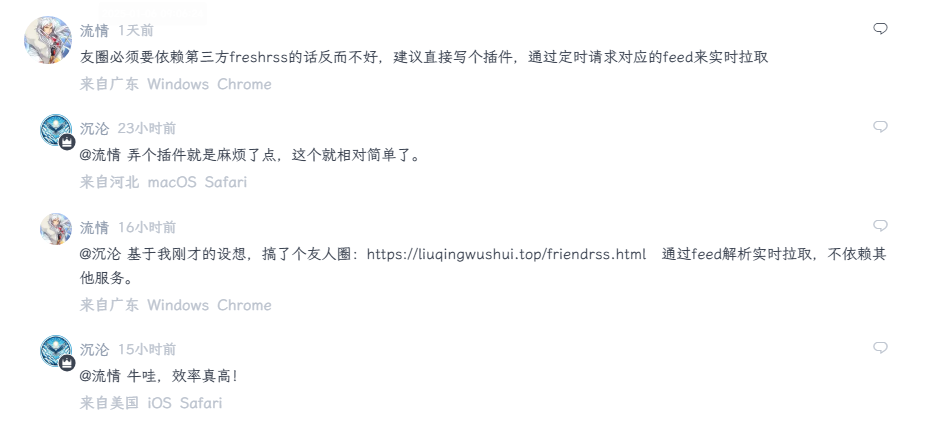
That discussion pushed me toward a better idea. If the latest updates could be parsed directly from each site’s feed in real time and then used to generate a local outrss.json, the biggest downside of depending on an external subscription tool would disappear. In other words, the feed data could still be collected, but the final result would remain local to the blog.
Once that clicked, the rest became much easier to imagine. On top of that, the visual style from another blogger’s friends-circle module, along with a few other examples, gave me a clear reference point. Having something concrete to look at solved another issue I had been worrying about: how to display it in a way that actually fits the theme instead of looking awkward or out of place.
At that point, there was not much reason to keep hesitating. Better to try it than keep thinking about it.
I started with a casual “let’s see what happens” mindset, and before I knew it, my own blog had a friends-circle section too.
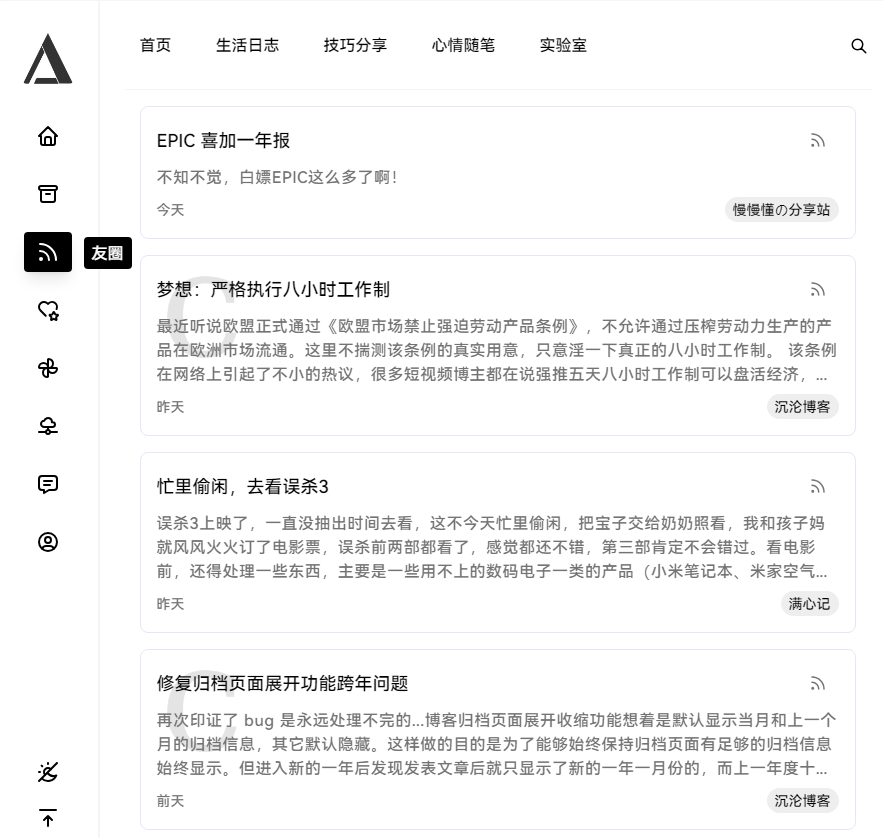
The implementation itself is fairly straightforward. The site requests and parses feeds, generates an outrss.json file, and then displays that data on the frontend. To avoid making requests too often, I added a cache check: the cache lasts for two hours. If more than two hours have passed, the site fetches the feeds again, parses them, and creates a fresh outrss.json. Otherwise, it simply loads the local file directly.
So if the friends-circle section ever feels a little slow when you visit, that is probably why. A short wait from one visitor can buy everyone else a smooth two-hour experience afterward, which is not a bad trade at all.
In the end, I have to admit it: the blog friends feed really does live up to the hype.