Why Product Details Rarely Make a New Product Succeed
The title sounds a little absolute, and maybe a little emotional too. But the point is worth discussing: when it comes to a new product, details usually do not determine success. At most, they enhance something that already works. In many cases, obsessing over details too early can even increase the chance of failure.
A product succeeds or fails for many reasons, and details are rarely the most direct one. For a new product, the first and most important job is to make sure it is useful to the intended user and that it actually works. Investment in detail design does not necessarily produce proportional returns at this stage. Sometimes the relationship is even negative: if the core functionality is still incomplete, the more effort you pour into polishing details, the more likely the product is to miss what matters most.
In that sense, details usually cannot decide success or failure on their own. They are often more like decoration added after the foundation is already solid.
A few comparisons make this easier to understand.
First, think about making a T-shirt. If the cut, fit, and fabric have not been figured out, it makes little sense to spend all your energy thinking about the graphic printed on it. A beautiful design may help sales, but only if the shirt itself fits well and feels right. A plain white T-shirt can still be worn. But if the cut and material are poor, even the most attractive print cannot make it a good piece of clothing.
Second, when people praise a product, they often talk about how impressive the details are. But that kind of praise can distract from the real reason the product matters. Without strong core capabilities underneath, all those elegant touches may only create a brief flash of appeal.
Third, details are often what comes after the essentials. They are like a fine cup of tea after a meal. If you have not eaten enough, or have no meal at all, even the best tea is still just tea. It cannot fill you up.
That said, the discussion becomes blurry if we fail to separate “details” from “importance.” Core functions also have their own internal components, and some of those may look like details from the outside. But for a new product, I do not think the core can be split so casually into “important parts” and “mere details.” The essential functions are rigid requirements. Every piece that is necessary to make the product valuable and operable belongs to the highest priority.
So what should come first?
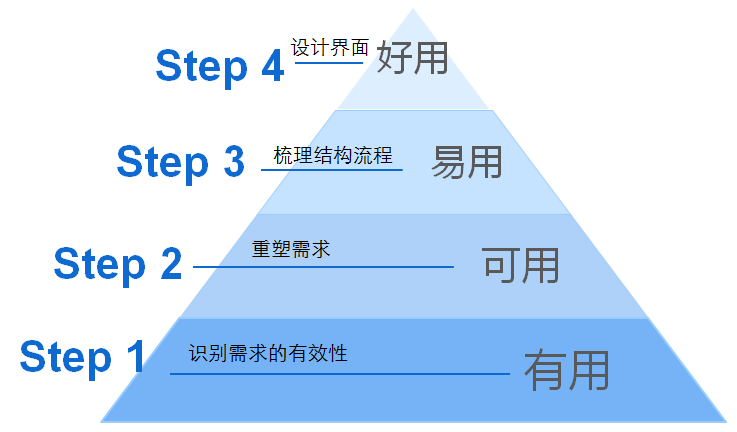
First: make it useful
“Useful” is a product direction that needs to be defined before development starts. A team must be clear about what the product is supposed to do and who it is for. If there is no clear functional definition and no clear user definition, then no amount of polish will save the product.
Second: make it workable
Once the direction is clear, the next step during development is to ensure the product “can be used.” This is the baseline standard. It means the product should not be blocked by functional bugs, and the core flow should actually run as intended.
For a new product, these two questions come before anything else:
- Is it useful?
- Does it work?
Only after both are satisfied does it make sense to spend serious effort on the next layer.
Then: make it easy and pleasant to use
This is where many details finally matter. “Easy to use” includes all kinds of refinement: interaction polish, interface clarity, smoother flow, and the subtle improvements that make a product feel better in practice. These details are worth attention, and they deserve deep research and careful iteration.
But for a brand-new product, they should not come before the core is finished. The first task is to complete the essential functionality, then improve it quickly through iteration. Getting stuck too early on the finer points of usability can slow development, distort priorities, and ultimately hurt the product instead of helping it.
That is also how most internet products are built in practice: finish first, then improve. The sequence is simple:
useful, workable, usable.
This is also why the MVP approach—Minimum Viable Product—has become such a popular path for launching new products. It fits this logic well: establish the minimum version that delivers value, make sure it functions, and then keep refining from there.