How I Nearly Got Scammed Booking Discount Flights—and Recovered the Money Fast
I almost talked myself into believing I was being careful.
Before the Spring Festival, I was getting ready to take my mother to Italy. The visa and itinerary were already sorted out, so all that was left was to buy the flights. Then I remembered that a former colleague had once told me about a ticket agent who had found very cheap flights for her group’s trip to France, and she had even forwarded me the agent’s WeChat contact at the time.
So I dug up that contact and asked whether she was still selling tickets. She was. Better yet, she said the flights I wanted were available immediately, and each ticket would cost a few hundred yuan less than booking directly through the airline or a major travel platform.
Before paying, I did what I thought was enough due diligence. I searched the company name in a business registry and found nothing obviously wrong. It appeared to be a legitimate company with travel and airline ticketing qualifications. The agent also had an IATA accreditation that could be verified on the official site. She did not operate through Taobao, but the payment was to a corporate bank account rather than a personal WeChat transfer, which made it all look fairly formal.
So I paid for four tickets.
It was already after 11 p.m. on Thursday when I made the payment. The agent said the tickets would be issued Friday morning and that she would send me the ticket numbers then. I went to bed without thinking too much about it.
The next morning my company had a team outing by Taihu Lake in Suzhou, so I was not watching my phone closely. Sometime after 11 a.m., I suddenly realized I still had not received any ticketing information. I messaged the agent and asked whether the tickets had been issued. She replied that she would send them over shortly.
More than an hour passed. Nothing arrived.
I sent two more messages asking again. Two hours went by without a reply.
A normal ticketing company going silent for two hours on a business day felt wrong. On impulse, I searched the recipient company name from the bank transfer on Xiaohongshu. The first few results were all posts demanding that this company return people’s money, along with warnings that it was a scam.
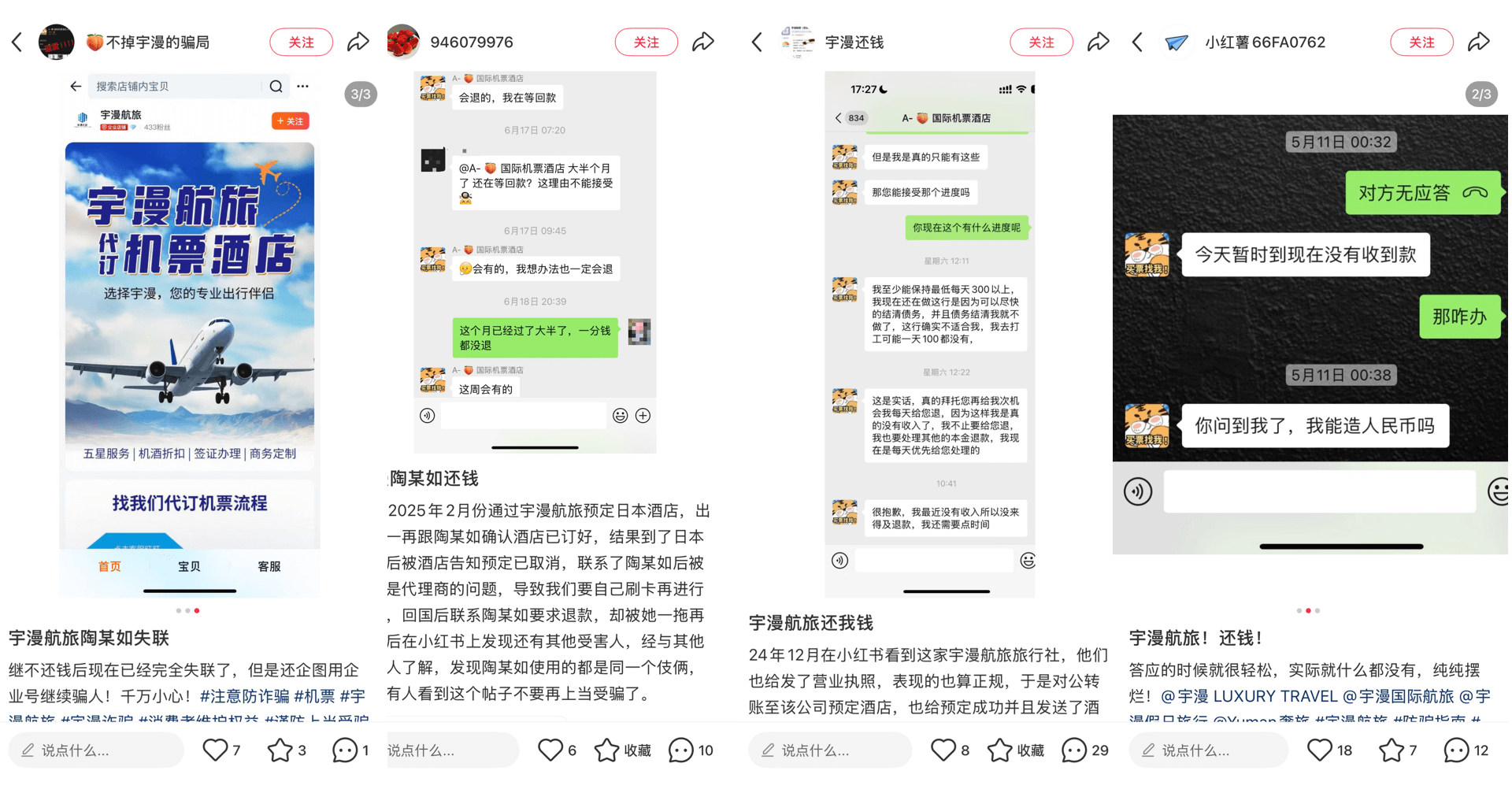
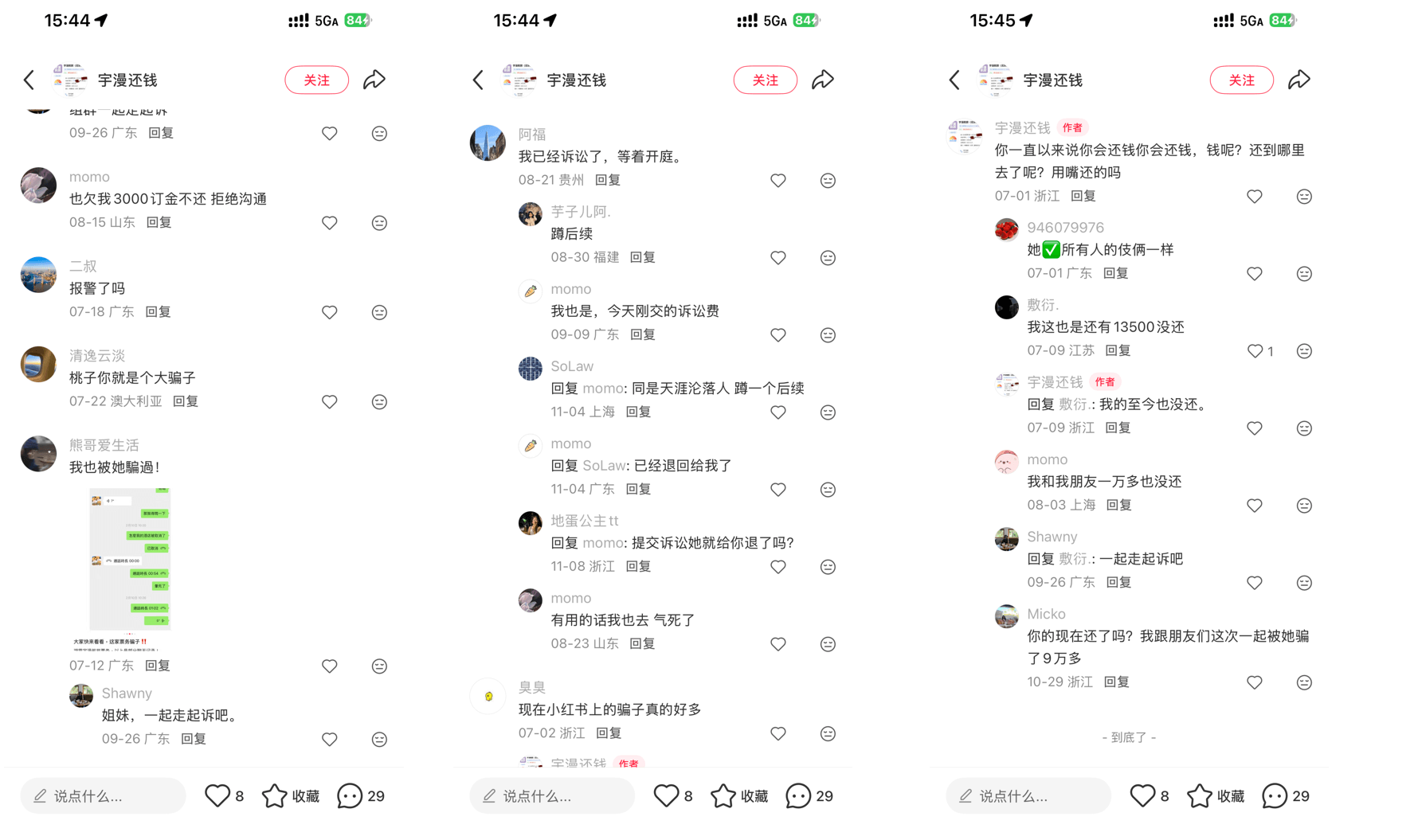
By then it was after 3 p.m. I was riding an electric scooter around the lakeside when I saw those posts, and my whole head started buzzing. I skimmed through the details quickly. The pattern described by multiple people was similar: the agency took deposits for flights or hotels, then either never booked them at all or booked them and later canceled them. When customers asked for refunds, the company stalled with endless excuses. In the comments, reported losses ranged from a few thousand yuan to well over one hundred thousand.
At that point I felt I was in serious trouble. But then, of course, the agent replied again—still using the same script: the ticket was about to be issued, I just needed to wait a little longer.
I decided not to confront her directly yet. If I accused her outright and she vanished, that would only make things worse—or so I thought at the time. Instead, I acted annoyed about the delay and asked for a refund. She immediately started saying that discounted fares took longer to issue. That did not match what she had said earlier about the seats being available and ready for direct issuance.
At the same time, I contacted the former colleague who had recommended her and asked whether her own purchase through this agent had gone smoothly. Had there ever been any dispute?
Her answer left me speechless: she had never actually bought tickets from this agent at all.
Back then, she had looked at the cheap France fares, but because the agent would not transact through Taobao, she had decided not to go ahead with it.
That was the moment I really understood how stupid this was. I had let my guard down simply because the contact came through someone I knew.
Once I was sure, the goal changed: minimize the loss
By then I was basically certain the agency was fraudulent. The only question was how to get the money back.
I reached out to several people who had posted about being scammed and asked whether they had recovered anything and how they had done it. A few very kind women shared their experiences with me. Some had gone straight to the police; some had filed civil lawsuits. From what they told me, money that had been directly transferred could sometimes be recovered, but extra losses caused by canceled trips were much harder to claim.
What I found especially absurd was that one person had allegedly been cheated out of over one hundred thousand yuan more than half a year earlier and still had not filed suit.
Based on what they told me, I gave the agent an ultimatum: issue the tickets or refund me, otherwise I would call the police.
She then called me. She asked whether I had found better tickets elsewhere, and how quickly those other sellers could issue them. If I wanted true discount tickets, she said, it was normal for the process to be slow; if I wanted a faster issuance, there was another option, but it would cost more.
I was furious and had no interest in hearing more. I cut her off and said: stop talking, either issue within 15 minutes or refund me. Then I hung up.
Looking back, I cannot help wondering whether the “more expensive option that can be issued faster” was an attempt to get me to send even more money.
I was already weighing two paths: report it to the police or sue.
And then something unexpected happened.
After I hung up, she issued one ticket.
Just one.
I had paid for four.
The one-ticket trick
This threw me off for a moment. The people I had spoken with earlier said that in their cases there had been no actual performance at all—no tickets, no rooms, nothing—which made reporting and litigation relatively straightforward.
But what about a case where one ticket had actually been issued? Could it still count as fraud?
One of the people I had spoken to told me yes—this too was part of the pattern. In hotel cases, some victims had received official-looking confirmations. Some even called the hotel and confirmed that the booking existed. Then right before check-in, the reservation would suddenly be canceled.
I called the airline first. I asked them to check which travel agency or OTA channel had issued that ticket. The answer surprised me: it had been issued through the airline’s own official channel.
I asked the customer service representative to confirm both the fare and the refund amount, because I wanted to estimate how likely it was that the agent would cancel it later.
What I learned was even stranger. The actual price of that ticket was higher than the per-ticket amount I had paid the agent, and the official cancellation fee was only about half of what the agent had claimed.
At that point the whole thing looked like a Ponzi-style operation. In order to stop me from demanding a refund and to prove that she could "issue tickets," she had apparently bought one ticket at a loss through the airline’s official website. Which also meant she almost certainly had no special low-cost supplier at all.
After thinking it over, I messaged her again and said I no longer wanted the remaining tickets. I demanded an immediate refund and said that if she did not refund me, I would go to the police.
She readily agreed—but said Friday was too late and that she would definitely refund me by Saturday.
I was still in Suzhou on the company trip and could not get back in time to report the matter locally, so I had no choice but to wait until Saturday afternoon when I returned to Shanghai.
The police report: useful, but not in the way I expected
Unsurprisingly, by Saturday afternoon she still had not refunded anything.
At moments like that I become very aware that I am not especially good at arguing with people. In this episode, AI tools were genuinely helpful. They helped me draft messages and also helped me think through how to report the case.
Based on the analysis I got, I had already started to suspect that calling the police might not do much. One of the other victims had also said that when she reported the matter locally in Hangzhou, the police told her it was an economic dispute and that she should sue in court.
Still, the suggestion I received was to do both: report it to the police and also prepare a lawsuit. The logic was simple. If the court later tried to say this was telecom fraud rather than a civil dispute and refused to accept the case, then having gone to the police first would at least get me a case acceptance receipt and, if applicable, a notice of non-filing. That would make it harder for the court to bounce the matter away casually.
So I organized everything: WeChat chat logs, transfer records, ticket information, and related materials. I printed them out and went to the Wujiaochang police station.
It was the first time in my life I had gone to a police station to file a report. It felt like unlocking a strange life achievement.
There are two places where you really see every kind of human drama: hospitals and police stations. Hospitals are tragic; police stations are chaotic in an entirely different way.
Only one statement-taking desk was open that Saturday, so everyone was queued up. The case before mine involved someone accused of stealing vegetables from a supermarket, complete with the familiar excuse of being unwell and forgetting to pay. The next case was about buying something on Xianyu and then getting blocked by the seller when asking for a refund. After that came a complaint involving a cheating husband and harassment from the mistress.
Because each matter moved painfully slowly, I waited from 7 p.m. until after 9 p.m. before it was finally my turn.
Now statements are typed directly into a computer, though the officer was not exactly a fast typist. As soon as he heard the outline of my case, he asked two key questions: could I still contact the agent, and had she promised to refund me?
I said yes to both.
His response was immediate: if the other party is still reachable, has issued one ticket, and has promised a refund, then this does not count as fraud in the criminal sense. If she delays and refuses to refund, then it is a contract-performance issue—an economic dispute that should go through civil litigation.
That was an important lesson.
Not everything should be taken to the police. If the matter is civil—such as water damage from an upstairs neighbor, or one person owing another money and refusing to pay—then the route is a lawsuit, not a police report. The police do not handle ordinary economic disputes. Likewise, if the issue is unpaid wages under an employment relationship, the usual route is labor arbitration.
Perhaps because they wanted to move things along, the officer still called the agent. On the first call, she once again promised that she would refund me. The officer told her that I was preparing to report the matter formally and that if the refund was not received within 15 minutes, the station would proceed normally.
Fifteen minutes passed. No money arrived.
The officer called again. This time she claimed that weekend timing made it impossible and that she would refund me on Monday, even if she had to scrape the money together herself. I did not believe her at all. The officer seemed skeptical too, and said they would proceed according to normal procedure.
My case was simple. The officer skimmed the chats for a few minutes and understood the basic situation immediately. Unlike the supermarket theft case, there was no need to review surveillance footage or question multiple parties. The amount involved was not huge, and the police were unwilling to escalate it into a formal fraud case. I asked what would happen if she later canceled the ticket she had issued. The answer was that they could not act on hypotheticals; if she canceled it, I could come back, but overall I should still go to court.
One thing did annoy me: when I looked over the written statement, it described the matter roughly as follows—on December 27, 2025 at 23:00, I booked tickets online through a company and transferred the money; on December 28 at 17:00, the company "successfully issued one ticket."
"Successfully issued one ticket" made it sound as if the other party had put in some noble effort and eventually succeeded.
If the police statement does not match what you believe actually happened, speak up immediately and ask for corrections. At the end, you are asked to sign and confirm that the written statement matches what you said.
After the statement was finished, the police printed a case acceptance receipt for me. Its role is limited: it proves that the police received the materials and made a basic record. It does not mean that a formal criminal case has been opened. In money-related matters like mine, any real filing would generally need to go to the economic investigation unit.
I got the receipt at around 9:45 p.m. I asked whether I would also receive a notice of non-filing, but the general impression I got was that, from their point of view, this matter should end there.
Filing a lawsuit turned out to be easier than I thought
Once I got home, I pushed through the rest in one go. I had AI help me draft the court filing materials, and I submitted my claim online through the People’s Court service website.

That process taught me several things I had never known.
First, if you want to sue over a financial dispute, you do not necessarily need a lawyer, and you do not have to go to the local courthouse in person. If your materials are in order, you can submit them online through the court’s website or through the corresponding WeChat mini program.
Second, even if someone owes you only a tiny amount, you can still file suit over a debt dispute. For ordinary online civil filings, the filing fee is often only 50 yuan. If you win, you can ask the defendant to bear that cost. So if the evidence is clear, self-filing in a money dispute can actually be very cost-effective.
Third, even if the other party does not currently have cash to repay you, property preservation measures can be used to freeze accounts and reduce the risk of asset transfers.
A civil complaint is not complicated. You mainly need to explain clearly what happened and what relief you are asking for. The court platform also provides standard guidance. I had AI generate a quick draft, and one of the other victims told me that the core evidence needed was simply the WeChat conversation and the proof of transfer to the company account.
Under Article 469 of the Civil Code, contracts can be formed in written, oral, or other forms, and data messages such as electronic exchanges and emails that can present content in tangible form and be accessed at any time can be treated as written form. In practice, WeChat chat records can serve as written contractual evidence as long as they satisfy the basic requirements of legality, authenticity, and relevance.
So yes—people should be careful what they agree to in WeChat messages.
Part of the reason people find litigation intimidating is simply that they do not understand the basic process and imagine that hiring a lawyer is unavoidable. The other part is probably the court system’s speed. Right after I submitted my filing, a prompt popped up saying there were 4,593 cases ahead in line waiting to be scheduled.
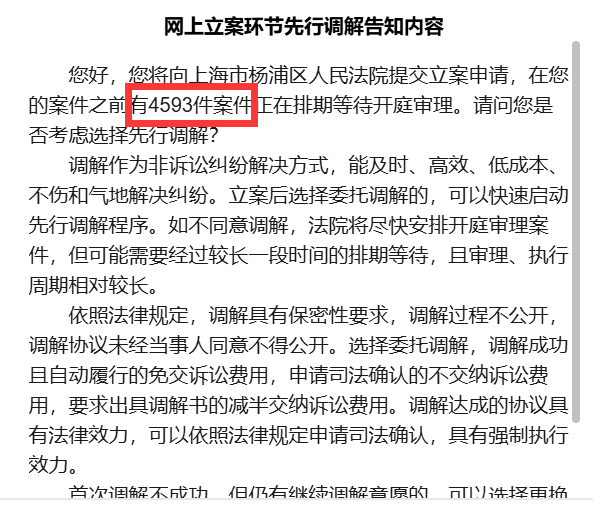
I suspect many people would close the page right there.
Still, not every case actually goes all the way to a hearing. Many disputes are resolved in pre-trial mediation. So if you really need to file, it is still worth trying.
Pressure worked faster than I expected
After finishing everything, I sent the agent one more message:
You promised that all the money would be refunded by Monday. The police have already recorded everything. If I do not receive the refund on Monday, I will proceed with the lawsuit, add you personally as a defendant, and return to the police station to update the case.
Once the filing was submitted, my mood changed from anger to calm. At that point I felt that, regardless of whether I got the money back, I had done everything I reasonably could.
It was not even a life-changing amount of money. It would not affect my ability to live normally. So why was I this angry?
My sister summed it up perfectly: it was a blow to my self-respect. I had trusted a former colleague’s recommendation and failed to verify properly, and I could not stand the fact that I had stumbled over something this foolish.
She was right.
I am no longer going to mock my mother for being tricked by livestream sellers. I have repented. Trying to save a little money while ignoring obvious risk is exactly how people get trapped.
Friends tried to comfort me by saying that trusting something with a friend’s endorsement is normal.
That night I slept very well.
Then on Sunday morning, a little after 11 a.m., the agent suddenly transferred me 2,000 yuan.
My guess was that the two calls from the police the previous day had scared her.
I asked where the rest was. She said she would return it as soon as possible. I did not bother responding.
Even though she had issued one ticket, I was still worried that it might be canceled before departure, especially because that matched what others had described. So I bought a backup ticket separately to avoid jeopardizing the trip.
That led to yet another lesson: the same person can buy two tickets for the same flight. Some airlines’ own official channels, such as Air China or Hainan Airlines websites, apps, or mini programs, may warn you that you already have the same itinerary. But many third-party platforms, such as Ctrip, do not flag the duplicate purchase.
Then the whole thing took one more unexpected turn
On Monday, I decided to keep pressing.
I messaged again: it is Monday, the deadline you gave the police. If you do not refund me, I will go back to update the case and confirm that this is fraud.
She replied almost immediately that she would definitely finish refunding everything that day.
Reason told me not to believe her. But honestly, when you receive a message like that, some part of you still wants it to be true.
Nothing happened all day.
Then after 6 p.m., she started sending money in small pieces through WeChat—1,000 yuan, then 800, then 500, then 200, and so on. I have no idea what she was doing or where she was scraping it together from. But by 11:58 p.m., she had actually refunded the full remaining amount.
So in the end, the money did come back.
At this point, the only unresolved risk is the ticket she bought. I still do not know whether anything will happen to it later. If that ticket is canceled, I will continue with the lawsuit.
There is also one administrative loose end: the case I filed online was still showing as pending review, and I could not find any obvious withdrawal button anywhere on the website. I will have to sort that out after the holiday.
Looking back, the reason she refunded me so quickly may simply be that she did not expect me to act so fast. I said I would go to the police, and within hours the police had called her. As one friend summarized it, my speed was probably the real shock.