Traveling Solo in Japan as a Hard-of-Hearing Person: What Accessibility Felt Like in Real Life
A long holiday finally arrived, and with it came the impulse to leave the country for once. After a lot of searching, I picked Japan for my first trip abroad: it was close, and it felt relatively safe.
To be honest, because I’m hard of hearing, I would not even dare to travel alone to another province inside China, and my family would never agree to it anyway. Every trip has to be with someone else, and even then I have to prepare more carefully than most people just to reduce the chances of being misled or running into avoidable trouble. But before going to Japan, I felt almost none of that usual anxiety. I had a strong intuition that the inconveniences I could overcome there would be fewer than the ones I deal with at home. Once outside China, I even suspected I might adapt better than people who rely only on hearing and prior travel experience.
A big part of that confidence came from Google Maps and from how easy it was to find clear route information online. I had this almost suspicious feeling that getting around Japan would be easier than traveling around the Jiangsu-Zhejiang-Shanghai region.
It turned out not to be an illusion at all.
Japan’s accessibility signage is impressively developed. I felt comfortable throughout the entire trip. It was the kind of place where, even if my hearing aid battery died, I still would not panic. For someone traveling alone just to breathe and clear their head, it felt unusually suitable.
On the night I arrived, though, I felt a delayed sadness in my hotel room. I had made it all the way there without problems and had barely needed to speak, but the experience still struck me as something rare in my life. It made me realize, very sharply, that many rights I should have had as a hearing-impaired person had simply been absent from the beginning where I come from. People like me were never truly included in the range of those being considered.
What I experienced on this trip was a kind of ease I had never experienced before. In public spaces, I felt no psychological burden and no instinctive resistance to going out. In China, by contrast, I often have to wage a long internal battle against exactly that resistance, usually framed by the familiar idea that I should “push myself out of my comfort zone.” But my thinking has changed. Why should “comfort zone” be treated as something shameful, as if choosing comfort were moral weakness? People should have the right to live comfortably. That should not be controversial.
In a place where I had spent years pretending to function like a hearing person, fighting and stumbling just to compete for the same chances and resources, and hearing endless praise for “suffering first so you can enjoy life later,” there was never much room to stop and think about any of this. It took being in a foreign environment to create the contrast. Only then did I feel the gap between what I had always treated as normal and what a more humane environment actually feels like. That gap brought with it a delayed disgust.
What made travel in Japan feel so easy
The first thing was the clarity of the public environment. The subway network can be complicated, but signs are everywhere, and if you slow down and pay attention, it is actually hard to get on the wrong train. Since there are many foreign visitors, service workers are also used to communicating through gestures and printed visual information. In restaurants and stores, people often show prices and totals on calculators or screens. They were patient.
I did not run into the impatient staff that many Chinese social media posts like to complain about. What I did see online instead were plenty of bizarre, casually racist posts from Chinese users, which said more about the people posting than about Japan. Recommendation algorithms really are toxic.
While traveling abroad, I also found myself more willing to express myself and try things. I felt more confident and more active than I do in China. I did not encounter anyone openly mean or exclusionary during the trip. Kyoto, in fact, gave me the best experience overall. People in Tokyo often had stronger personal boundaries and were not especially warm, but they were still polite and patient.
Returning home created a brutal contrast. After landing, what hit me first was the smell of cigarette smoke and exhaust fumes. Then there was the rideshare taxi I had called being snatched by someone else. Then the public spaces full of barriers, blockades, and defensive design meant to guard against other people. For a moment, the comfort I had just experienced felt almost unreal, like something I had dreamed.
Accessibility is not abstract when you actually need it
Japan has a lot of slopes and stairs. For wheelchair users, it is clearly not an ideal landscape. Even for non-disabled people, all the constant climbing up and down is tiring. I can understand why someone living there would feel that inconvenience acutely.
But in many places, if you keep going a little farther, you can usually find an elevator. There are also ramps for strollers. Compared with China, the accessibility infrastructure is still far better.
After walking huge distances every day, I often came out of subway stations feeling too exhausted to deal with another staircase. Fortunately, Google Maps has an accessibility option, and while trying to find elevators in stations, I regularly saw wheelchair users, older people, and travelers carrying heavy luggage doing the same thing. Elevator access is one of those things that benefits almost everyone.
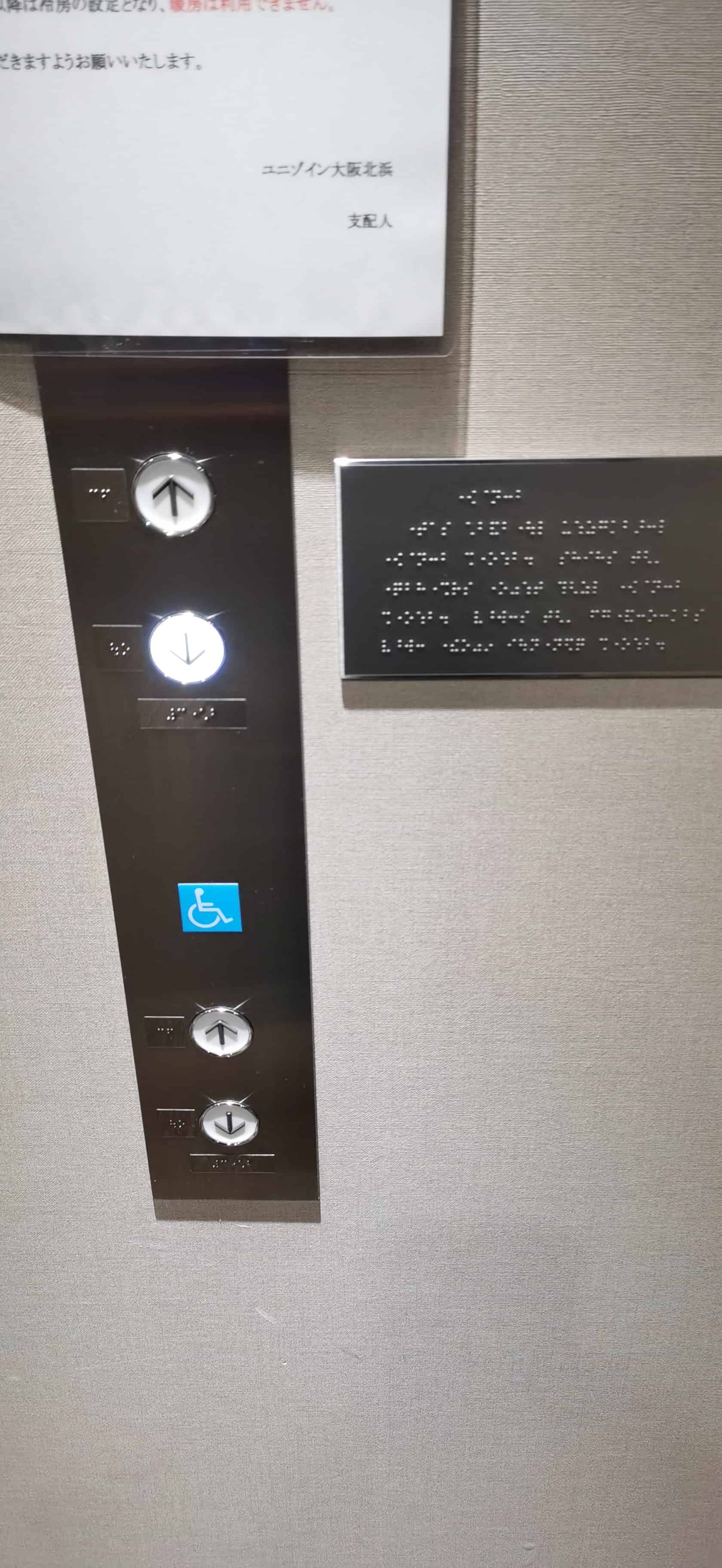
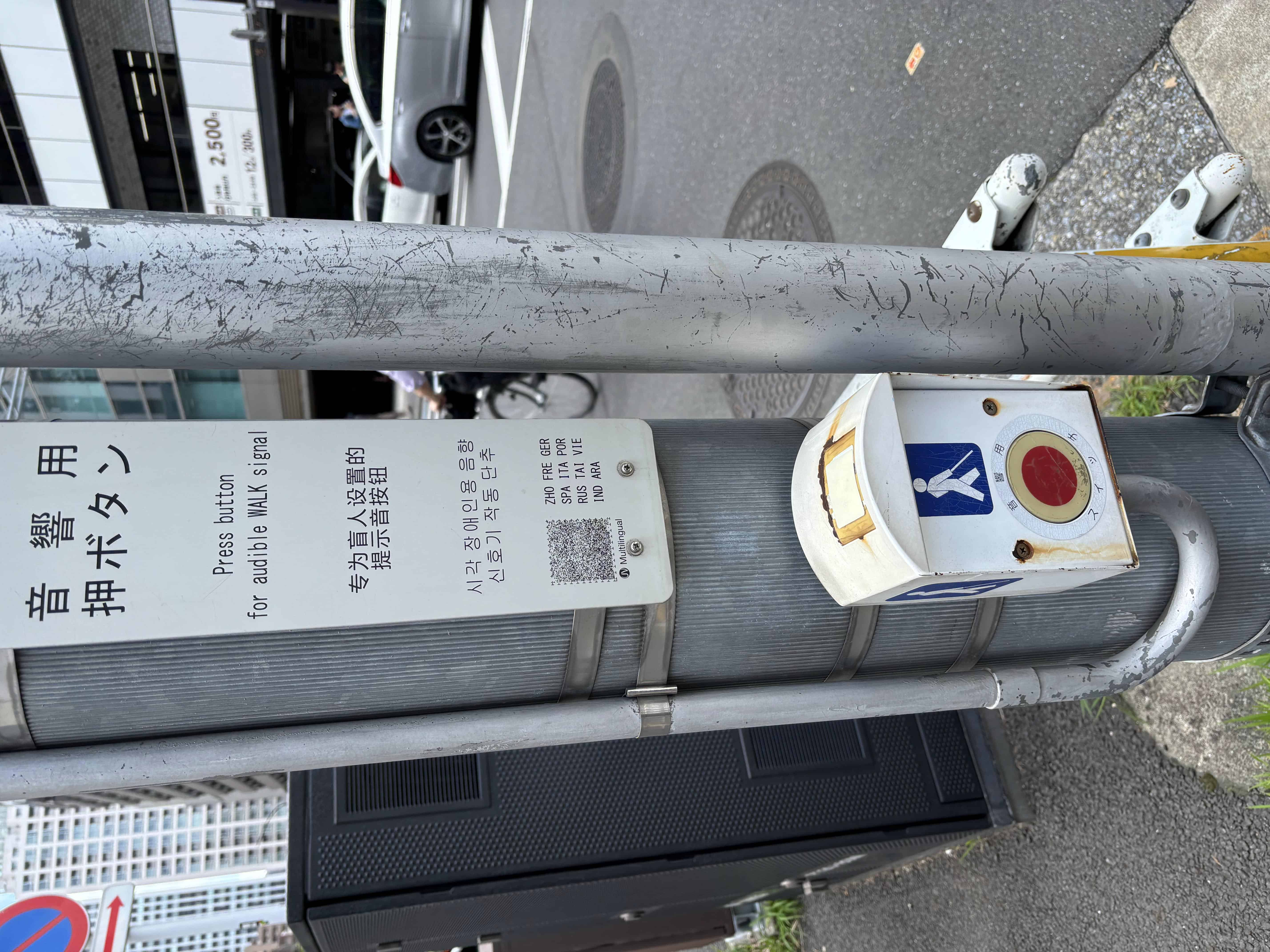
As for facilities for blind and visually impaired people, some train ticket machines had tactile keypads. At certain crossings, there were buttons on roadside poles that activated audible signals specifically for blind pedestrians, and some of them were labeled in four languages. Crossing the street felt less stressful in general.
It reminded me of an old anime episode where a programmer left a dying message in braille. When I first saw it years ago, I found it dramatic and almost implausible. Now it makes much more sense. Braille is genuinely widespread in Japan.
The tactile paving also seemed much more thoughtfully installed. It appeared where it was actually needed. Sidewalk crossings consistently had it. Even late at night I could hear the crossing signals for visually impaired pedestrians—loud, clear, impossible to miss.
Of course, I cannot speak for the lived experience of blind people themselves, and even in a place where braille is common there must still be many small failures and areas needing improvement. But from what I observed, Japan is far better suited to visually impaired people than China is.
A country that can wake even me up
During the trip I also experienced Japan’s earthquake alert system. A little after six in the morning, my phone blasted out an emergency alarm louder than any alarm clock. It was so loud the whole hotel could hear it. Even I—someone who usually cannot hear my phone alarm at all—was woken up by it.
Being awakened like that was strangely memorable. Once I checked the details and saw the epicenter was in Toyama Bay on the Kansai-side coast, more than 200 kilometers from Yokohama, it turned out to be a false scare for me, so I went back to sleep. Small earthquakes are not worth fleeing from, and big ones may not give you the chance anyway.
That moment also made me think: even in a place where accessibility is handled relatively well, disabled people are still the ones most likely to struggle in a disaster. It made me curious about whether there are social studies in Japan documenting how vulnerable groups are affected by earthquakes. There probably are.
Is Japan truly a good place to live? That depends on who is answering.
From my own perspective, if I had the chance to live there as a citizen, work under equal conditions, pay taxes, have normal access to social security, pursue my interests, and build an ordinary life, then many disabled people who want a different future would probably be willing to accept even the risk of earthquakes—or the possibility of dying in a foreign country because of a natural disaster. Because for people in our position, the first set of things matters more. In more ableist societies, those basic conditions are easier to strip away, squeeze out, or ignore. Anyone who has lived through that knows it can feel far more terrifying and far less controllable than disaster risk.
Why I relaxed after only a few days
I went on this solo trip first and informed my family afterward, so naturally they worried about my safety. But after three or four days, I felt my nerves actually loosen for the first time, because I had not encountered any real obstacle.
Maybe part of that is personal. I am used to solving problems alone and do not have a strong habit of depending on others. Even when there were minor issues—like not hearing clearly while ordering food—they did not register to me as real barriers.
The dark joke here is obvious: once a disabled person has survived the travel conditions of mainland China, the problems they meet abroad often feel like small cases.
Only after leaving did I realize how much of my life in China had been spent unconsciously overcoming obstacle after obstacle. For the first time, going out felt easy. I looked forward to interacting with people. Finding directions, shopping, ordering food, trying unfamiliar things—none of it came with the usual psychological burden. As long as I had internet access, things moved smoothly. Being a foreigner likely gave me a certain margin of tolerance too.
But then again, when people are faced with a language they do not speak, with unfamiliar customs and strangers around them, they are all, in some sense, in a situation not unlike hearing impairment. The real difference is attitude. Human interaction can cross the borders of language. If people genuinely want to communicate, intentions can be conveyed.
That applies both to face-to-face interaction and to the systems and facilities people build. At the core, both are extensions of respect for human worth.
What I felt in Japan was a social logic that seemed to say: life is already short and uncertain, and everyone moves through periods of strength and weakness, so why not make daily life and human interaction a little more comfortable?
That atmosphere of respect for people is something I have never felt in China. Not once. I no longer expect to.
A small incident at a hotel front desk stayed with me
One of the smallest moments from the trip ended up staying with me the longest.
I needed to send my suitcase ahead from a hotel front desk. After arriving in Japan, I realized that people there generally speak even more softly than I had imagined. Japanese pronunciation is much lighter than Chinese, and that has always been one reason I hesitate over whether I should seriously continue learning Japanese. If I already struggle to hear my native language even with hearing aids, then Japanese—or Japanese-accented English—would only make communication harder and waste everyone’s time.
So I used a translation app in advance to explain to the front desk that I was hard of hearing.
Unexpectedly, one of the hotel staff, a very handsome young man, knew a little Chinese. Once he understood what I needed, he patiently took out paper and pen and carefully wrote to me, character by character, in his Japanese-style written Chinese so we could discuss the luggage delivery. I have no idea whether he was mixed-race or had some personal reason for learning Chinese, but from his handwriting it looked like the very typical way Japanese people write Chinese characters. He seemed to have genuinely worked hard at it.
He helped me make the confirming phone call, fill out the shipping form, and reminded me what time I had to bring both the form and the suitcase down the next morning. When I came downstairs early the next day, he was still at the front desk. I do not know whether he had been working a night shift, but I was honestly amazed. He smiled, greeted me again, and used paper and pen once more to confirm the contents of the shipment and whether there were fragile items inside.
He was meticulous and responsible.
It was the first time in my life that I had the thought: so this is what it feels like to meet a normal man who is polite, competent, careful, and genuinely professional. That realization was weirdly shocking in itself.
Even after leaving Japan, I still occasionally think about that evening and about him writing Chinese characters stroke by stroke so we could communicate. In a super-aged society like Japan, maybe encountering hard-of-hearing people like me is not unusual at all.
It was a very small act, and perhaps he did not even consider it a special kindness. But that tiny kindness from a stranger in a foreign country rescued something in me. After that, when I later encountered foreigners asking for directions on the streets of Shanghai, my first instinct was no longer to shrink away. I actually hoped I could help.
I wanted to pass on useful information together with even a small amount of goodwill, because when someone is away from home, reducing barriers really matters.
What kindness means when you rarely receive it
This is almost laughable to say, but as someone whose auditory nerve was damaged and who was therefore classified into the domestic category of “disabled,” I have genuinely found it hard to feel kindness in more than twenty years of life in China.
Kindness has become something almost embarrassing to speak of, as if it belonged to fiction, sentimental fantasy, or abstract declarations about human love that are too fragile to survive ordinary life.
From childhood to adulthood—at school, in hospitals, in pharmacies, in malls—I have rarely encountered strangers willing to slow down and spend a few patient minutes communicating with me. I have almost never met anyone who, after learning about my hearing problem, could continue looking at me with a normal expression. Most strangers, after realizing I cannot hear well, reflexively show some expression that makes me uncomfortable: shock, pity, heaviness. Even in hospitals, this happens often.
That reminds me of a real joke from years ago. When Shanghai was preparing for the World Expo, relatives from my mother’s hometown came to visit. They walked on the tactile paving that had been specially installed and asked, “What is this bumpy thing underfoot?” When they were told it was for blind pedestrians, the immediate response was amazement: “Wow, are there really that many blind people in Shanghai?”
Fourteen years later, China has 17.31 million visually impaired people, but the environment around them has only become harsher. Near my home, tactile paving is cracked, broken, missing, or buried under countless shared bikes and electric scooters. In some places it has been “thoughtfully” moved farther aside, with an implicit message of not getting in everyone else’s way.
Sometimes I still feel fury when I see a newly repaired road where the brand-new tactile paving has been deliberately routed around a pillar; when I see accessible bathrooms in public libraries kept locked; when I see reading rooms for visually impaired users that are almost never open; when I see museums and bookstores that never once considered wheelchair users.
This kind of “making way” is really the daily erasure of tens of millions of disabled people. They are forced to lower their expectations and treat that lowered state as normal. “The minority should obey the majority” too often becomes nothing more than a slogan that justifies the majority’s neglect, spatial encroachment, and bullying.
What other people dismiss as trivial details can be the final straw for the people who actually need them. Day after day, year after year, they have to spend more time and mental energy than everyone else just to get through small things.
I am tired of constantly surrendering comfort in every detail of life, and of having to spend extra time and money just to buy the kind of convenience other people get without effort.
The kind of technology that tells you whether you were ever considered a user
On this trip, I deliberately bought an unrestricted iPhone in Japan because none of the Chinese domestic phones I have ever used supported connecting to my hearing aids.
I want to use hearing-aid Bluetooth functions. I want to listen to music, use internal audio freely, hear podcasts, watch online courses, and study foreign languages like anyone else. During my undergraduate years in shared dormitory living, even such a small wish was difficult. Everything was inconvenience after inconvenience.
Every time domestic phone brands release a flashy new model, with loud advertisements and a dazzling list of features, the message I receive is simple: I am not included in the imagined customer base.
As for when they will support all brands of hearing aids—or when some app claiming to care about hearing-impaired users will finally build truly useful subtitle accessibility—I do not expect much anymore.
I increasingly feel that I should reject more decorative but useless experiences in life and save my time for what is concrete, practical, and able to benefit others.
I also swear that from now on, I will stop apologizing for every unavoidable inconvenience, slowness, or delay in my life.
Human-caused harm is something I have been forced to taste since I was three years old. Sometimes I am genuinely astonished by how many people can go through life without frequent hospitals, without ever being “selected” by birthplace, household registration, natural disaster, or human disaster, and can therefore lie back in comfort discussing abstract happiness in abstract language. Against a population of 1.4 billion, the 85 million disabled people in China—and the many more struggling in silence—still somehow appear tiny.
Leaving your familiar environment changes what you can finally see
Only by stepping outside what has become normal to you and entering another culture, another environment, another set of everyday assumptions, can you reach a different kind of mental clarity.
You begin to sort out which parts of your pain are truly psychological and which parts are produced by the environment. You become more logically certain that some suffering was never your fault.
At the same time, you also understand more deeply that being people-centered is not some grand theory. It is a simple and powerful form of kindness. Its effect on one person’s life is enormous, and from there it radiates outward: shaping public infrastructure, spreading awareness, making room for discussion and improvement, encouraging respect for different groups, and making inclusion more ordinary.
Eventually, you begin to believe that sustained exchanges of goodwill—responses, habits, even faith in one another—are the real foundation of change and hope.
In a society obsessed with performance, utility, and deference to power, kindness, tolerance, and patience often become scarce goods. Worse, they can be treated as if they were a burden on others’ time. Once a human community loses the idea of the human, everyone’s life is diminished, trivialized, and trampled in some way.
Recently I saw yet another online discussion complaining about subway accessibility and how difficult it is for wheelchair users to get through. I do not even want to call many of the comments “limited understanding.” What they show much more clearly is a foul, malicious arrogance—the kind that turns disabled people into spectacle, consumption, and entertainment, revealing the extreme insecurity of people who have never looked beyond the bottom of their own well.
Posts like that always trigger a physical and emotional resistance in me. Anyone whose body differs from the mainstream is always at risk of being turned into a joke, an inspirational prop, or material for cheap internet memes. In this country, people with physical impairments are constantly forced into anxiety and pain around identity itself, instead of simply being allowed to stand, walk, breathe, and pursue the things that non-disabled people take for granted.
That is an environmental disgrace.
What is astonishing is how this reality can still embolden social-Darwinist arguments. And once the people actually affected speak up to say they feel insulted or hurt, they become targets again, reduced to “content” for others.
Then, when silence and invisibility become the safest way to survive, a certain type of self-satisfied, supposedly rational and caring non-disabled person appears and says in a patronizing tone: yes, your lives are hard, but you should stop complaining so much and speak up more—make yourselves visible, start with yourselves, change society from your own position.
What these shallow minds fail to understand is that disabled people in China occupy enormously different class positions and cognitive worlds, yet many share one instinctive understanding without needing to be taught: they cannot afford the malice of the general public or the risk of testing how low human behavior can sink.
And besides, if the very concept of the human has never taken root, if kindness cannot grow in the social soil, if the broader culture is spiritually barren, how can individual speech ever expect even basic respect?
Accessibility and public inclusion are not niche demands. They are public issues tied to birth, aging, illness, disability, and death. In the end they can benefit everyone. But instead of broad civic responsibility, what often happens is that the burden gets shifted from the majority onto the minority, while the minority’s actual needs remain invisible.
Demanding that individuals bear such a massive public responsibility and personally pay for the failures of the environment only exposes how primitive, arrogant, and underdeveloped public governance and public participation still are. No matter how much people polish the rhetoric, it has not crossed the threshold of modernity.
After stepping away for a moment
After briefly removing myself from that environment, I can look back and feel one thing quite clearly: I am glad I still will not become part of those arrogant, politically narcissistic groups.
If I cannot leave permanently, then the rest of my life should at least involve sharpening my judgment and knowledge, and finding every possible way to prevent their toxic thinking and language from invading my life.
Traveling once does not transform my material reality, nor does it fill me with fantasy. The best thing travel can do is let a person feel, in the gaps between walking and thinking, a direct connection to survival itself.
The most valuable perspective we gain from difference is often not grand or abstract. It is close to life. It helps us adjust our minds in practical ways.
Life will keep going. I will still be someone who spends a lifetime struggling against the unfreedoms imposed by the body and by material conditions. People love talking about freedom in the abstract, about its symbols and its theories. But the part of freedom I pursue—the most basic and most important part—is much simpler, and much more visible.
Freedom is not mainly the right to change yourself or the world around you.
It is the right not to be forcibly changed by it, and the right to keep resisting every form of discomfort imposed on your life.