Enneagram Type 4: Traits, Inner Conflict, and Emotional Patterns
Type 4 is drawn to difference. People with this core type want to feel distinct, original, and deeply themselves. They are highly sensitive to emotion—their own and other people’s—and that sensitivity often gives them an artistic, expressive quality. They tend to trust feeling over convention, seek emotional intensity, and carry a kind of unusual magnetism. At the same time, they can become preoccupied with pain, nostalgia, and what seems absent from life.
Your Enneagram profile
The score chart below shows how strongly each of the nine Enneagram types appears in your results. In the chart, a larger section means a stronger fit. In the discussion below, core type refers to your main basic personality type. “Type 5,” “Five,” and “5” all mean the same thing; the number is simply a shorthand.
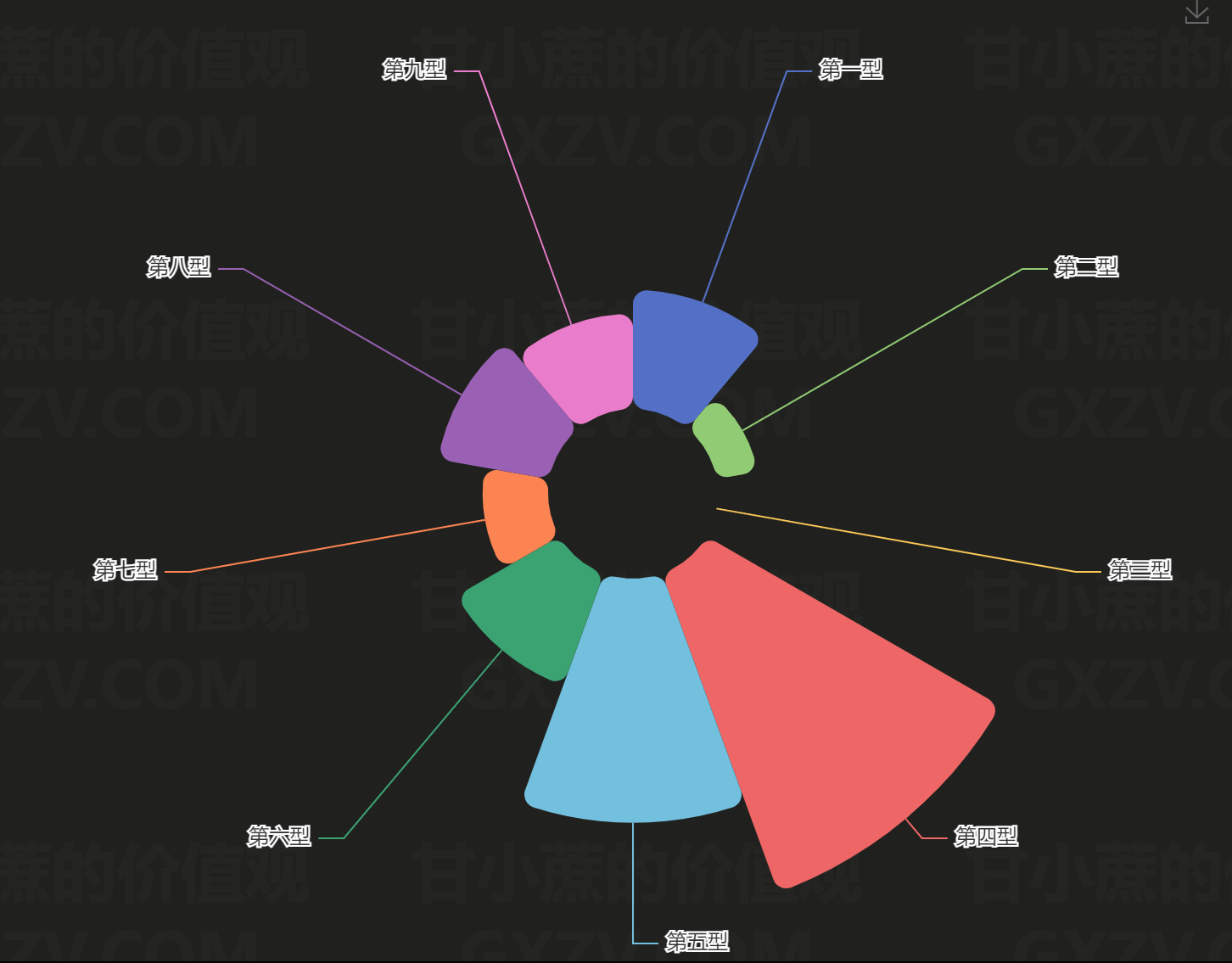
Your core type: Type 4
Your core type is Type 4, so the focus here is on how this personality structure shapes your emotional life, your fears and desires, and the way you tend to function in relationships and work.
A Type 4 may have a Three wing, a Five wing, or elements of both. Type 4 is also connected by Enneagram arrows to Type 1 in growth and Type 2 under stress. This is not a full-length report; what follows is a focused interpretation based on the core type.
The basic pattern of Type 4
Type 4 is often called the Individualist because identity is built around being different from others. Fours often feel that no one fully understands them or loves them completely. Many carry a sense that they are uniquely gifted, uniquely flawed, or both at once. More than most types, they notice their personal differences, their shortcomings, and the places where they feel somehow incomplete.
Healthy Fours are strikingly honest with themselves. They do not easily deny, soften, or disguise what they feel. They can look directly at their motives, contradictions, emotional conflicts, and even the parts of themselves they are not proud of. They may not enjoy what they find, but they do not usually run from it. This willingness to face inner pain gives them an unusual ability to endure suffering quietly and to tell the truth about their own experience, even when that truth feels personal or shameful.
Yet many Fours live with the persistent feeling that something essential is missing. They may not be able to name it clearly. Is it confidence? calm? willpower? social ease? Whatever it is, it always seems as if other people have more of it. With enough reflection, many Fours realize that what feels unstable is their very sense of self. They struggle to hold onto a clear, grounded identity or a social role that feels natural.
Although Fours often feel different from others, that does not mean they truly want isolation. In that sense they differ from Type 5. They may feel self-conscious or awkward, but they deeply want connection—especially the kind of connection in which someone sees and values their hidden, private self. This is why Type 4 is so often described as the romantic of the Enneagram.
If that longing for recognition goes unmet for a long time, the Four may start building identity around difference itself. Individualism becomes both shield and comfort: everything must be done alone, in a personal way, on personal terms. The underlying story becomes, I am myself; no one understands me; I am different and special. Beneath that stance, however, there is often a quieter wish to share in the ease, confidence, and belonging other people seem to enjoy.
The fantasy self and the unstable identity
Type 4 often struggles with low self-esteem and a negative self-image. To compensate, many create an idealized inner image of who they might be—more refined, more gifted, more exceptional than their actual lived habits support.
One example often given is of a Four who spends long stretches listening to classical music and imagining himself as a great concert pianist in the mold of Vladimir Horowitz. But his actual commitment to practice falls far short of that fantasy. When asked to play for others, he feels ashamed. His real ability may be respectable, but because it does not match the imagined self, it becomes a source of humiliation.
Over the course of life, Fours may try on multiple identities, adopting styles, tastes, and qualities they admire in order to discover who they are. But beneath these experiments there is often uncertainty. The difficulty is that their identity depends heavily on feeling, and feeling is always shifting. When Fours look inward, what they find is not a fixed essence but a moving pattern of emotional responses.
In that sense, Type 4 is deeply attuned to a real truth about human nature: inner life is dynamic and changeable. But the Four often tries to build a stable identity out of moods. Certain feelings are accepted as “me,” while other feelings are rejected as “not me.” By preserving and expressing particular emotional states, the Four hopes to remain authentic.
The attachment to loss
One of the central challenges for Type 4 is learning to release old feelings. Fours often revisit emotional wounds and continue carrying resentment, grief, or disappointment long after the original event has passed. Longing itself can become familiar. So can dissatisfaction.
This is why Fours sometimes miss the real value in their lives. Their attention returns again and again to what has been lost, what never happened, or what remains just beyond reach.
A Type 4 once described this state with brutal clarity:
“When I’m out in the world, I often fall apart. I’ve been through one relationship disaster after another. I hate my sister’s kindness—and most people’s kindness too. For years there has been no real joy in my life, only fake smiles. Since a real smile never seemed to belong to me, I kept longing for everything I could not have. My longing could never be fulfilled, because I now realize I was attached to ‘longing’ itself rather than to any particular outcome.”
There is a Sufi story that captures this trap. An old dog, abused and nearly starving, finds a bone and drags it to a safe place to gnaw. It is so desperate that it keeps chewing until all possible nourishment is gone. Later, a kind old man notices the dog and quietly begins preparing food for it. But the dog is so fixated on its bone that it refuses to let go. In the end, it starves.
Type 4 can fall into the same pattern. As long as they remain convinced that something is fundamentally wrong with them, they cannot fully receive or enjoy their strengths. Letting go of the identity of the wounded one may feel like losing the self altogether, and that touches their basic fear. Growth begins when the Four sees that much of the personal story being repeated is no longer true—or was never wholly true to begin with. Once the old story stops defining the present, the old emotional charge begins to loosen.
The Four’s emotional dilemma
Type 4 often carries a lasting memory of abandonment, or at least the feeling of having been left emotionally outside. From that comes a deep sense of lack.
There is often melancholy in the Four’s gaze, a sentimental attachment to what has been lost, and a dramatic quality to life itself. Their goals can feel distant, and what they most want can seem unavailable by definition.
The inner world of a Four resembles the tragic romantic figure in literature: even with social recognition or material success, contentment remains elusive. What they yearn for is often lost love, distant love, future love—the imagined love that will finally redeem everything.
What is easily available may hold little appeal. Their attention is pulled toward what cannot be had.
Fours may make decisions from a clear grasp of facts, but just as often their choices shift with emotion. In conversation, they are highly attuned to tone, implication, atmosphere, and subtext—sometimes more than to literal meaning.
Depression is a familiar state for many Fours. It can stop life in its tracks and trap the mind in endless replay:
- “If only I had done it differently…”
- “If only I could have one more chance…”
The Four’s mind can get caught on if, if, if the way a needle sticks on an old record.
Most Type 4s know this emotional territory well. Some resign themselves to it and withdraw into long periods of solitude. Some stay constantly busy, hoping activity will outrun heaviness. Others turn the darkness into artistic inquiry, using it to explore painful dimensions of human experience.
Alongside depression is another state that strongly attracts Fours: melancholy. Unlike flat despair, melancholy has beauty in it. It is born from lack, but it carries a sweet sadness, like fog over a desolate shoreline. In these shifting emotional climates, Fours often feel intensely alive. Because their inner world changes so quickly, permanence can seem unreal.
The wound beneath the longing
At the core of Type 4 is the sense of deficiency and lowered self-worth: If I had been more valuable, would I have been abandoned? Many Fours move through life feeling that the source of love was once there and then taken away. The question underneath is often: I was loved once—where did that love go?
Experiences of abandonment, or experiences that feel equivalent to abandonment, often leave a deep mark. Even in adulthood the feeling may remain active. The habit of wanting what is unavailable can operate almost unconsciously, but it still causes suffering.
Fours habitually focus on what is missing. What is present may feel dull by comparison. They often crave intense, passionate relationships that promise emotional fulfillment. They hunger for love.
Even their sadness can become seductive. While grieving the loss of love, they may simultaneously romanticize an ideal future partner. The current relationship can begin to feel like a rehearsal for the real love that has not arrived yet—the love that will finally awaken the true self.
This is one reason success alone rarely satisfies a Four. Even if they achieve something meaningful through years of effort, attention soon shifts to the next absence. Get the job, and now what matters is a partner. Get the partner, and single freedom starts to look more desirable. Lose both, and now both seem necessary again. The focus continually moves toward the missing piece. What is already in hand can seem lifeless and ordinary.
Why relationships can become unstable
The romantic style of Type 4 can lead them to undermine what they have. Everyday reality—picking up a partner’s socks, tolerating small habits, dealing with ordinary imperfections—can feel like an offense against the ideal image of love. The dream is exquisite; the lived relationship is flawed. Small irritations become magnified.
- “She’s politically clueless.”
- “He doesn’t understand music at all.”
- “How can he put the toothbrush in the cup like that?”
Having to tolerate what feels crude, banal, or aesthetically offensive can stir anger in a Four because they are trying to protect an inner image of beauty.
Once they realize that intimacy demands compromise, they may start finding reasons to push the partner away before the fantasy is fully destroyed. In those moments, the partner becomes the obvious one to blame. A hurt Four can say extraordinarily cutting things, especially when trying to prove that the other person has failed them.
But once distance returns, longing returns too. This creates a push-pull dynamic: when closeness is available, they retreat; when it is gone, they reach for it again. Their love life can become cyclical—breaking apart, yearning, reuniting, and repeating.
To feel safe, many Fours try to keep others at arm’s length. They do not want total distance, but too much closeness also feels dangerous. Real intimacy threatens to expose their flaws and trigger abandonment. If a partner grows tired of this guarded distance and threatens to leave, the Four may suddenly collapse emotionally, become physically unwell, or turn fierce self-blame inward in an effort to preserve the bond.
When the fear of abandonment is activated, all barriers can fall at once. Old feelings of loss surge back, and the response may become dramatic: extreme disappointment, wild accusations, emotional chaos, or even suicidal thinking in severe cases.
Many Fours say that these emotional highs and lows make them feel intensely alive. Ordinary happiness can seem thin in comparison. They experience themselves as observers of normal life, set apart from it—different, singular, the lead character in their own emotional drama. To let go of that heightened emotional existence can feel like sacrificing uniqueness itself.
For this reason, the pursuit of simple happiness may even seem threatening. There is often a fear that peace would mean losing contact with the inner emotional world—or worse, becoming ordinary.
Levels of health in Type 4
When Type 4 is healthy
Healthy Fours often produce original, moving, and even groundbreaking creative work. They can transform personal experience into something that serves a larger good. They are capable of helping others see art, meaning, and identity in new ways. Major shifts in artistic style and sensibility are often driven by people with this kind of unconventional imagination.
Because healthy Fours have learned to stay with complex emotions without being ruled by them, they undergo a kind of inner metamorphosis. Out of self-acceptance comes freedom, and out of freedom comes authentic expression.
When Type 4 is average
At average levels, Fours channel pressure into creative outlets and may seek out groups of like-minded people for support and inspiration. They are emotionally intense, reflective, and strongly committed to authenticity. But this can also become self-absorbed, and other people may end up paying the price in patience and emotional labor.
At this level, Fours can become highly sensitive to criticism while remaining convinced of their own emotional truth. They may actively seek praise and affirmation. If someone appears to imitate their experience or borrow too directly from their identity or style, they can take deep offense.
When Type 4 is unhealthy
Unhealthy Fours can become overwhelmingly moody, fragile, and depressed. Rumination grows so strong that it blocks creativity rather than feeding it. In more extreme states, they may lose their grip on reality and turn to intense sensory escape, including alcohol or hallucinogens.
The search for the “missing piece” becomes a dead end—circling, repeating, and never arriving. If they refuse to confront their self-destructive habits and thought patterns, they may keep falling into the same hole and making the same mistakes. At their worst, they become convinced that they are fundamentally broken. Under severe stress, a Four may erase their online presence entirely and cut themselves off from the world.
Type 4’s growth does not come from denying emotion, but from no longer making suffering the center of identity. Their gift is depth. Their challenge is to stop confusing depth with loss.