The Deeper Meaning of The Bronze Statue on the Hill: Faith, Power, and the Sorrow of the Poor
A light autumn rain can make certain stories feel heavier than they first appear. The Bronze Statue on the Hill, a fairy tale by the Japanese writer Nankichi Niimi, is one of them.
Niimi wrote this story in 1942, when he was gravely ill and only twenty-nine years old. He died the following year. During that final period of his life, his writing turned toward large and difficult questions—life, death, religion, society, and the human condition. This short tale carries the softness of a fairy tale on the surface, but underneath it holds a cold and far-reaching meditation on how ordinary people live under shifting forms of power. It also helps explain why Niimi came to be remembered as "Japan’s Andersen." Reflections marked by sympathy for human beings tend to outlast their moment.
Unlike the fresher, gentler mood of his earlier children’s stories, this tale speaks in a quieter but harsher register. Its language remains tender, yet what it sings is not innocence. It is a lament for people at the bottom of society.
If myth belongs to humanity’s childhood, then fairy tales may be its most beautiful moment of adulthood: beauty that appears only after suffering has already been seen clearly. Niimi had looked directly at pain, and even at the end of his own life he did not abandon warmth. His criticism of humanity is severe, but he does not deliver it with open fury. He tells it slowly, almost gently, through the form of a fairy tale.
Five bronze figures, five stages of belief
In chronological order, five bronze forms appear in the story: the poet Hans, the doctor Hed, the young commander Pedro, the watchdog Hanet, and finally the church bell.
These are not just objects that change shape over time. They are symbols. Niimi uses them to reflect the social world surrounding the poor and the powerless. In literal terms, they are statues made of bronze. In a more abstract sense, they stand for belief itself—for what a community admires, obeys, remembers, or is taught to revere.
The story traces how the bronze is repeatedly recast. Each transformation reveals a different kind of collective faith, and behind each kind of faith lies a different social order.
The first statue: the poet and the innocence of early society
The bronze statue first comes into being because the king likes Hans’s poetry and orders the villagers to cast his likeness.
A poet immediately calls to mind the figure of the wandering singer, a type rooted in a very old world, extending back to ancient Greece and even earlier. That world was marked by primitive living conditions, material scarcity, and the early rise of kingship. People lived close to nature, feared it, and depended on it. They lacked wealth, but they were also less trapped by the elaborate burdens that come with wealth. And in its earliest form, royal authority was not yet purely a machine for extracting social riches; it could still appear as a force for gathering a scattered society together.
Hans, then, symbolizes the environment in which common people lived at the dawn of social formation. In such a world, villagers are inwardly calm, but also deeply aware of the power of nature. In the darkness of an ancient night, what lets them sleep peacefully may be nothing more than a weak campfire and the cradle-like songs of a poet.
Hans’s poetry resembles the kind of songs found in old folk traditions: spontaneous, sincere, uncalculated expressions of feeling. The king’s fondness for Hans and the villagers’ willingness to cast his statue amount to a recognition of that shared emotional truth. They admire the poems first; only after that does authority guide the act of statue-making.
That detail matters. Hans’s poetry produces no material profit. A statue built for him has no practical use. It is therefore a collective act without obvious utility, born from spiritual recognition rather than calculation. It functions almost like a totem. In the early formation of human society, such symbols strengthen communal cohesion.
At this stage, bronze still stands close to genuine belief.
The doctor: usefulness enters belief
The next version of the statue is the doctor.
Here, utility begins to enter the picture. The doctor saves the villagers, so they cast his likeness in gratitude and in memory of his service. This is no longer a purely spiritual act in the same way the poet’s statue was. The doctor has directly improved people’s lives. He has restored bodies, and in doing so has indirectly increased the community’s strength and wealth.
So yes, there is a practical element here—but it remains rooted in the villagers’ shared will. The doctor harms no one, exploits no one, and the statue reflects a sincere collective judgment.
Belief has shifted, but it has not yet been corrupted.
The young commander: war, hierarchy, and the price paid by the lower classes
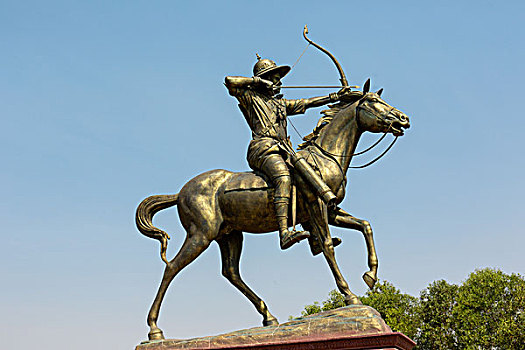
Later, the villagers recast the bronze once again, this time to commemorate a young commander who died defending the village and the country.
Now the act of memorialization becomes not only useful, but dramatic and conflicted. Some villagers do not want to contribute money. Their objection is direct: my son also died in the war, so why does he not receive a statue too?
That question opens onto the deeper social meaning of the story. Human beings have now begun fighting wars over social resources, and war is paid for with the lives of ordinary people.
The fallen commander was born in the village. In essence, he too came from the lower strata of society. He is not the only one who died. Many other young men from the same village have also been sacrificed. Yet only he is granted the honor of bronze, because his status differs from theirs: he is a commander.
The statue therefore marks a decisive change. Belief is no longer simply admiration or gratitude. It has become entangled with hierarchy.
Once there is monarchy and war, there are also classes. The story says the proposal came from the villagers and was meant to honor the dead, but one cannot avoid another possibility: perhaps someone hoped to flatter those in power, or perhaps those in power themselves encouraged the decision. After all, when lower-class people win glory in war, they are said to defend both home and nation. But "defending the nation" also means securing the rule of those above them.
The collective interest of the village is important here. War has already damaged that interest by taking away part of the younger generation. Then comes the first darkly comic turn: because some villagers refused to donate, there is not enough bronze, and the horse ridden by the young commander ends up oddly small—like a dog.
That absurd detail prepares the next transformation.
The watchdog: when power no longer needs truth
The story’s sharpest irony arrives after a theft at the landlord’s house. The watchdog chases the thief and dies. The landlord then orders a statue of the dog.
At the unveiling, he solemnly explains the new statue to the villagers. But the truth is ridiculous. The dog is nothing more than the commander’s undersized horse with slight modifications. As for the "young commander," he happens to have the same Caesar-style mustache as the thief, so the landlord does not even bother altering him. He simply renames the commander as the criminal. A crack, five centimeters deep, is carved into the figure’s head, and the landlord tells the villagers this represents the fatal blow dealt to the thief.
At this point the tale reaches the height of its grim humor.
And yet the villagers do not object.
They remain silent because they fear the landlord may take back the land they rent from him.
That silence is crucial. The dog’s statue does not arise from collective will at all. It is imposed from above. Popular feeling has been diluted under arbitrary power. Once the dog’s bronze form stands on the hill, people only say, in passing, that Hanet was a good dog.
The statue has now fallen from the seat of belief into the dust. It no longer represents anything the villagers truly revere. They mention Hanet casually, but no one dreams of imitating the dog by defending the landlord. Their own lives are already miserable enough; in social terms, they are not so different from the animal being honored above them.
This is the tale’s most mocking episode, but also one of its darkest. It shows a society in which the people have lost not only belief, but also the right to truth. Power can rename the past, alter symbols at will, and demand acceptance. The poor know the lie, yet cannot resist it.
The final transformation: the church bell and manufactured faith
At the end of the story, the bronze is recast for the last time and becomes a bell in a church.
Niimi describes how a magnificent church is built on the hill. When seven great bells are hung in the tower and their beautiful sound begins to ring out, the people feel the kingdom of God rise in their hearts.
On the surface, this seems peaceful, even uplifting. But fairy tales often reveal the harshest truths through the calmest language, and the ending invites suspicion rather than comfort.
Why is there a church in this village at all? A church properly belongs to a Western setting, yet here it stands in a Japanese village. And it is not a thriving sanctuary. It is described as the oldest building in the village, long neglected: the stained glass has been blackened by soot, beside the mural of Christ’s birth clings an old swallow’s nest, and the stairs of the bell tower creak so frighteningly that no one dares climb them.
Why would such a ruined structure be renovated?
That question matters if one wants to see the story’s darkest layer.
When the first Western missionaries arrived in the East, they did not bring only churches. They also came in the shadow of guns and cannon. In that sense, the church can signify the violent insertion of an outside civilization. Local people resist foreign enemies, perhaps even defeat them, and the church—as a symbol of cultural intrusion—falls into disuse.
But later, after the village has grown large, the church is repaired and elevated again.
The village’s growth suggests material prosperity. Yet material growth does not erase social crisis. Instead, it conceals it. A new type of landlord has emerged, and the people have already lost their former beliefs. The ruling class of this new era exercises control more subtly: it uses religion to govern the masses.
The final recasting of the bronze means that a new ruling order has violently dismantled the people’s own will and handed them a tailor-made, empty faith in its place. Once people become enchanted by the "kingdom of God," society has entered one of its darkest moments.
This is why the bell matters so much. It is seductive. It sounds beautiful. It offers spiritual elevation. But it also symbolizes mental domination. It is a form of authority that no longer needs to command openly, because it teaches people what to long for.
Why the story still feels contemporary
The bell in the church does not have to remain in the church.
Its modern equivalents can appear elsewhere. Any system that keeps people absorbed in pleasant illusion while draining away their capacity for truth, judgment, and self-awareness belongs to the same symbolic world. When people from the lower ranks of society spend their days immersed in shallow forms of stimulation and temporary psychological gratification, the resemblance is hard to ignore. Their condition is not so different from the villagers standing beneath the church tower, listening to the bells and feeling themselves drawn toward a misty, manufactured paradise.
That is why the story’s warning remains so sharp. One must be wary of pleasures that quietly impose themselves as substitutes for meaning. One must be wary of drifting into a faith that is empty precisely because it feels comforting.
Perhaps this is the truest implication of The Bronze Statue on the Hill: beneath the soft shell of a fairy tale lies a mourning song for the poor. Its sadness does not come only from poverty itself, but from something even more devastating—the repeated theft, reshaping, and replacement of the people’s belief.