Remembering Yu Jie in the Age of Algorithms and Amnesia
Writing about Yu Jie makes me uneasy. He is, in every sense that matters here, someone who crossed lines.
First he stepped beyond the boundary usually tolerated for a so-called fighter for free thought. Then he crossed the political and moral limits that the present Chinese climate is willing to accept. After that he crossed the geographic boundary of mainland China itself. And in the years since settling in the United States, judging from the kind of "free speech" he has chosen to exercise, he seems to many to have crossed yet another threshold: the moral baseline tied to national feeling.
To discuss a person like this is not without risk. It feels a little like playing with fire. Online space has never truly been a lawless zone, and Chinese citizens living on the mainland still have to speak within the framework of the law. Once milk and bread are no longer the pressing issue, and we finally have time to sit down and talk about freedom and democracy, it still seems wiser to approach authority with restraint rather than fanaticism or aggression.
That thought leads naturally to another subject: the personal blog.
About twenty years ago, the rise of personal blogs had a profound influence on Chinese intellectual life. One of the biggest changes was that blogs broke the old monopoly traditional media had over public expression. Ordinary people suddenly had a platform to publish their own views. This decentralized mode of communication helped grassroots culture emerge, allowing non-elites to take part in public discussion and challenge established systems of authority in discourse.
A second change came around 2005, when platforms such as Blogcn became major gathering places for ideas in the Chinese-language world. Their user bases were once said to be growing by 50 percent a month. Technology gave subcultures and marginal opinions room to circulate, and this in turn helped push social thought away from collectivist habits toward more individual forms of expression. Cultural and intellectual voices became more diverse.
A third shift appeared after 2009, when blogs and microblogs together became important platforms for online democratic participation among university students. Their personalized and relatively authentic style cultivated a new generation of internet users who were more conscious of public affairs. That mode of participation laid some of the groundwork for later civic discussion in the social media era.
The blogging age opened a process of cultural democratization. Content creation moved from being dominated by professional institutions to something much broader and more participatory. That change encouraged freedom of thought, but it also exposed the disorder that comes when there are no unified rules. In time, this helped usher in a new order in which algorithmic recommendation began to dominate cultural production.
Put more simply, this is the age of Douyin and Kuaishou. A person watches what he likes, and the mainstream apps keep feeding him more of the same. They satisfy the senses efficiently, but the content they display is also heavily filtered politically.
In an era governed by recommendation algorithms, most people are amusing themselves into numbness. The small minority who still try to think have far less influence than reflective writers once had when personal blogs were thriving. Even so, I still believe that traditional paper reading, along with the continued existence of personal blogs, remains one of the better ways for people interested in the humanities to train their minds. Read and think; think and write. In 2025, there are not many people still maintaining a blog in that spirit, but someone ought to keep doing it.
As for building a personal blog, I have always wanted a platform that feels relatively loose and less constrained, which is why I chose Hong Kong hosting that does not require mainland filing procedures. The next step I have even considered is blocking search engine indexing. But even then, I know perfectly well that I am always under the gaze of online public scrutiny. Writing on a blog still requires caution. One may talk about freedom and democracy, but one should not become a person who crosses the line.
And so back to Yu Jie.
Around the turn of the millennium, I read parts of Fire and Ice and Cries in an Iron House. During my high school and university years, Yu Jie influenced me deeply. He even shaped the style of my own later writing. After graduating from university in 2005, work became busy and I paid less attention to him. Later I saw online news that he had gone to the United States, and after that I hardly encountered much about him at all.
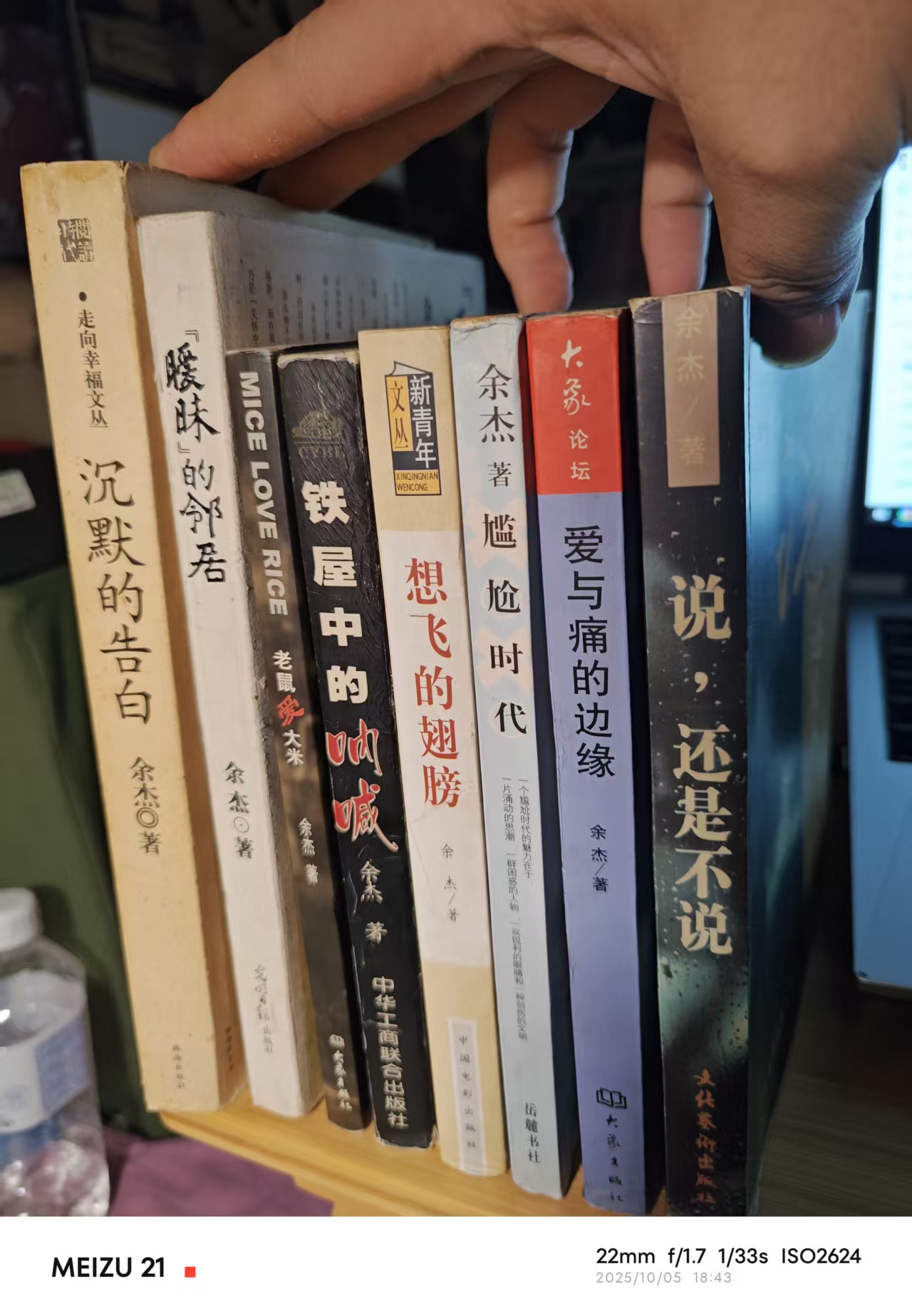
Recently, being idle at home and mentally sluggish day after day, I felt the need to pick up books again just to sharpen my mind. That is when I thought of Yu Jie. I own only one of his books in print, To Speak or Not to Speak, though I still have more than a dozen of his ebooks on my computer. Because he had been a writer I cared about in my youth, I wanted to gather the rest of his books.
That search led to an unsettling discovery. His works are now difficult to find online, and in print there are only a few scattered secondhand copies available on Taobao. Search engines yield surprisingly little as well. For someone once known everywhere as the "gifted Peking University writer" Yu Jie, the trace he leaves online is now remarkably faint. Only then did it hit me that this once forceful and highly visible writer seems to have been effectively erased from the mainland public sphere.
Using AI tools, I tried to piece together a rough picture of him.
Yu Jie, born in October 1973 in Pujiang, Sichuan, is a contemporary Chinese writer and scholar known for sharp social criticism and intellectual essays. He was once regarded as one of the representative figures in the return of a critical stance among Chinese intellectuals in the 1990s. His trajectory moved from domestic critic to overseas exile, and both his writing and his thought have become increasingly controversial.
He was born into an intellectual family. His father was an architectural expert, and his mother taught in a middle school. Influenced by that environment, he began publishing literary work at the age of twelve and had already produced more than 100,000 words while still in secondary school. In 1992 he entered the Chinese department at Peking University with strong exam results, and in 2000 he completed a master's degree in literature under Chen Pingyuan and Xia Xiaohong, focusing on modern literature. During his years at Peking University, he wrote nearly two million words of cultural criticism and intellectual essays, laying the foundation for his later reputation as a polemical writer.
His early works from 1998 to 2000 established his name. Fire and Ice (1998) became the book that made him famous. Its harsh criticism of Peking University, the Chinese education system, and broader social culture caused a sensation. Reports at the time described sales in the millions over two years, and the media gave him labels such as "Peking University prodigy" and "the mainland's Li Ao." The book carried forward a style reminiscent of Lu Xun, targeting the spiritual predicament of intellectuals and the flaws of the system.
Cries in an Iron House (1998) focused more directly on freedom and human rights, with equally sharp language, and was seen by some as extending the critical spirit associated with Lu Xun. To Speak or Not to Speak (1999) gathered commentary on cultural flashpoints and further consolidated his image as a public intellectual.
From 2001 to 2004, his writing entered a somewhat different phase. Fragrant Hill (2001), a semi-autobiographical love story, recorded his relationship with his wife Ning Xuan, whom he met because of Fire and Ice, and showed a gentler, more compassionate side of him. A Bruised Reed (2002) turned toward questions of human nature and faith, in a more restrained style. Light and Shadow (2004) brought history and reality together to examine the relationship between power and the individual, and was named by Asia Weekly as a best commentary work of the year.
His career also ran into trouble. After receiving his master's degree in 2000, he faced a turning point when a research institution that had signed with him ultimately refused to take him in. The conflict between his critical stance and the system became increasingly public after that. He turned more toward studies of Republican-era history and exile, and took part in civil literary activities such as the Independent Chinese PEN Center.
Another AI-generated summary added several details to this portrait. In 1998, it noted, Fire and Ice brought Yu Jie broad attention as a "Peking University talent," in part because it used personal growth as a lens through which to reflect wider social problems. At the same time, his highly moralized and combative critical style drew criticism of its own. In 2001, he was drawn into an academic integrity controversy over an essay on Water Margin, accused of borrowing arguments about the character Wu Song from Zhu Dake's Psychoanalysis of the Hooligan. In 2012, his departure for the United States was read by Western media as proof that criticism was no longer tolerated in China. After that, he increasingly turned toward Christian theology, writing works such as Silent Confession and exploring the relationship between faith and freedom. According to that summary, his writing abroad shifted from direct social criticism to a more religious-philosophical register, using a Christian perspective to reflect on how totalitarianism deforms human nature, while insisting on a moral position of answering to one's own conscience.
After 2010, Yu Jie's life changed decisively. Because of ongoing criticism of the Chinese government, he reportedly faced growing restrictions on speech. In January 2012, he moved with his family to the United States, held a press conference in Washington, accused China of suppressing freedom of expression, and applied for political asylum. In 2018, he announced that he had become a U.S. citizen. Claims attributed to him about being of Mongol descent and attempts to downplay a Chinese identity triggered strong controversy and drew accusations of betraying his roots.
His years in America have been no less contentious. According to the information I found, he has mainly spoken through social media and overseas dissident circles, frequently attacking China's political system and offering readings of historical events that critics see as distorted. Yet because of what many describe as an increasingly extreme stance and limited scholarly depth, he has not gained broad recognition in mainstream American society. Some of his remarks were considered opportunistic and inflammatory, including attacks on the contributions of the Chinese American scientist Zhang Shoucheng and insults directed at the late U.S. Supreme Court Justice Ruth Bader Ginsburg as being "pro-China."
As for his literary presence, the same materials suggest that after 2012 he has had little visible publication in Chinese, and even fewer works in English. Most of his speech seems to circulate on platforms such as Twitter, often with very little engagement, giving the impression of speaking largely to himself. Reports also portray his life in America as financially strained, dependent on modest assistance and donations, and socially marginal because of his long-held anti-China posture and his distance from Chinese communities there.
This is where the difficulty of judging him begins.
Yu Jie's early work won admiration through sharp observation and a powerful critical edge. He was once treated as a successor to the spirit of Lu Xun. But his later years, at least in the eyes of many critics, have damaged that reputation severely. To them, he drifted toward extreme speech in order to appeal to Western anti-China forces. Some commentators see in this transformation the identity anxiety and loss of values experienced by certain Chinese intellectuals under globalization. And yet, even then, his early writing retains historical value for the way it dissected Chinese society during a period of transition.
Perhaps in an age devoted to mass entertainment, people will gradually forget this once passionate young writer who wrote with compassion, denounced totalitarianism in a fierce prose style, and cried out for what he understood as democracy and freedom. Or perhaps, as material life advances, and as genuine democracy and freedom are one day realized step by step, and as the broader ideological climate changes, people may eventually look back on the earlier Yu Jie with more tolerance. Or perhaps it is simpler than that: as political filtering of online information grows deeper, those of us living on the mainland simply find it harder and harder to obtain any news about him at all.
So I write this as a small act of remembrance.
And I continue to collect whatever secondhand copies of his books can still be bought. From time to time, with nothing urgent to do, I look again at this man who crossed the line. I read what he wrote when he was young, and let my own thoughts dance for a moment at the edge of danger.