Why Emergency Lane Misuse on Highways Keeps Happening
Whenever toll-free holiday travel begins, major expressways across China often grind to a halt. On the busiest routes, traffic jams can turn highways into parking lots. Once congestion sets in, the emergency lane is frequently taken over by private vehicles, leaving police cars, ambulances, fire trucks, and other emergency responders unable to get through.
Every year, authorities promote civilized driving and remind motorists not to use the emergency lane illegally. Yet the problem persists, and it is becoming more visible as the number of vehicles on the road keeps rising and highway congestion grows worse.
In many cases, serious highway backups are triggered by accidents, and most of those accidents are minor collisions caused by poor driving behavior. The increase in inexperienced drivers may also play a role, but it is far from the only issue. Unsafe habits are common: random lane changes, excessively slow driving, straddling lane markings, and even throwing objects from moving vehicles on the highway. The sheer variety of these behaviors suggests that overall driver discipline still has a long way to go.
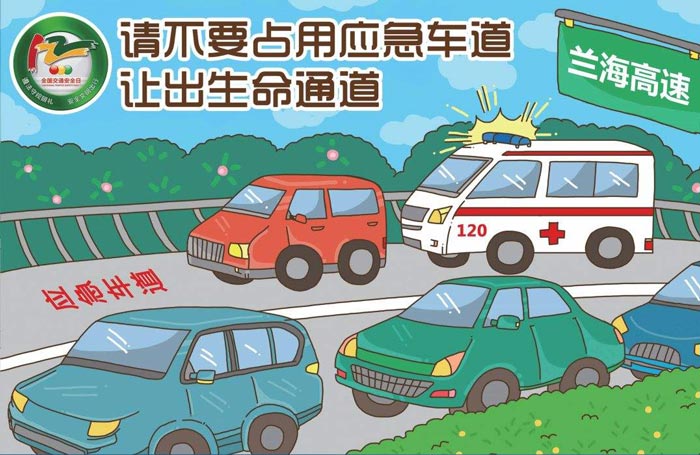
Emergency lane abuse is especially easy to notice because it happens both in normal traffic and in heavy congestion. Even when traffic is flowing, some drivers use the emergency lane to overtake. When the road is jammed, large numbers of vehicles simply drive in it as if it were an extra lane.
Why do so many people do it? The article points to two main reasons.
The first is weak enforcement in practice. Illegal use of the emergency lane is often difficult to document, which means many drivers believe they are unlikely to be caught or punished.
The second is that the current penalty is not strong enough to deter people. Under the existing rules, occupying the emergency lane brings a 200-yuan fine and a 6-point deduction. The legal basis comes from the Road Traffic Safety Law of the People’s Republic of China, which began trial implementation in 2004. According to the article, that standard has remained unchanged for 15 years. In today’s context, a 200-yuan fine no longer carries much weight.
The contrast with broader economic growth is striking. China’s GDP was 13.65 trillion yuan in 2004 and 90.03 trillion yuan in 2018, an increase of 6.6 times over 15 years. During the same period, per capita disposable income rose from 9,421 yuan to 39,251 yuan, an increase of 4.17 times. Yet traffic fines are still largely based on the same 2004 standard, so their deterrent effect has weakened significantly.
Judging from current income levels, the article argues that traffic fines should be raised by about five times to remain meaningful. In that logic, a 200-yuan fine would become 1,000 yuan. For violations with a stronger element of deliberate wrongdoing—running red lights, using the emergency lane, or throwing objects from a highway vehicle—the penalties should be even harsher. One example mentioned is Shenzhen, where the punishment for occupying the emergency lane is a 3,000-yuan fine and a 2-point deduction.
The broader point is that congestion is not caused only by growing car ownership. Failure to follow traffic rules is also a major factor. There is only so much room to widen urban roads or limit the number of vehicles. Improving the efficiency of traffic management is what really matters if road operations are to improve.
Lighter penalties are only part of the problem. The other major issue is that many violations are hard to investigate and punish.
At present, footage from private dashcams generally cannot serve directly as the basis for punishment under existing traffic rules. There have already been cases in which dashcam footage recorded by individuals was accepted, but in reality not everyone is willing to take violation videos to the traffic authorities and file a report. The fact that roads fall under different jurisdictions makes reporting even more time-consuming and inconvenient.
Some cities, including Shanghai and Shenzhen, have already considered allowing traffic violations captured by personal dashcams to be used as evidence for enforcement. If traffic authorities eventually provide an online submission channel for such videos, and if people who submit verified violations receive some financial reward, the proportion of violations that are actually investigated could rise substantially.
Another consequence of weak punishment is that it pulls otherwise law-abiding drivers into rule-breaking behavior. When people who follow the rules find themselves constantly blocked by those who do not, some of them eventually join in.
A common example appears at highway ramp entrances where only one lane is available. Vehicles often force their way in from the emergency lane and merge into the regular traffic lane at the ramp entrance. Drivers who stayed in the proper lane are then forced to slow down and give way, otherwise a scrape or collision becomes likely. Because the emergency lane is usually less crowded, vehicles in it can move faster. Meanwhile, traffic in the legal lane is slow because of congestion. That speed advantage allows emergency-lane drivers to keep cutting in line, one after another, until the normal lane can no longer move smoothly at all.
That is why illegal occupation of the emergency lane remains so hard to eliminate. One side of the problem is driver behavior and road etiquette. The other is that the current Road Traffic Safety Law of the People’s Republic of China no longer fully matches present-day conditions. Revising the relevant rules has become an urgent need.