From Generating Content to Generating Worlds: Five AI Shifts That Will Shape 2026
Artificial intelligence is entering a different phase. The rapid model improvements and wave of new tools seen in 2025 pushed the technology beyond demonstrations and early experiments. In 2026, the more important question is how deeply AI can be integrated into software, scientific research, business processes, and everyday products.
Five developments stand out: AI-generated interactive environments, the rise of reasoning models, AI-assisted scientific discovery, systems that can learn continuously, and the growing strength of open-source models. Together, they point to a shift from impressive outputs to systems that can operate, adapt, and solve more demanding problems.
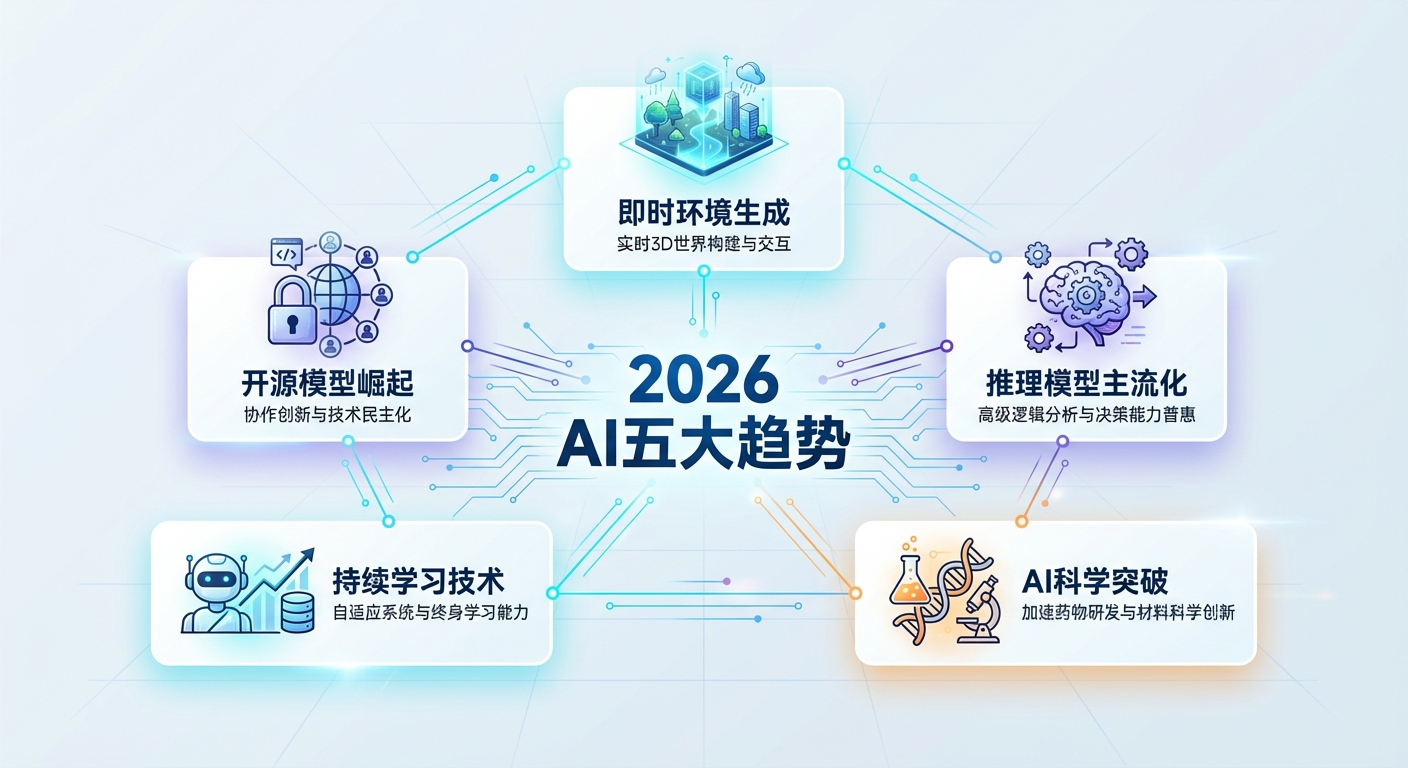
1. AI will generate environments, not just images
Generative AI began by producing text and images, then expanded into audio and video. The next step is more ambitious: creating complete, interactive three-dimensional worlds in real time.
Google DeepMind’s Genie 3 and Marble, developed by World Labs, represent this direction. Instead of returning a static picture or a pre-rendered video, these systems aim to produce virtual environments that users can explore and manipulate.
A prompt such as “a sunny beach café” could become a navigable 3D scene. A user might walk around the space, move objects, alter the weather, or change the setting while the environment responds immediately. The experience is closer to interacting with a game than waiting for a conventional rendering pipeline to finish.
The main advances associated with Genie 3 are:
- Real-time generation. The system is designed to turn text or images into 3D worlds at extremely high speed, described as reaching millisecond-level responsiveness.
- Interactivity. The result is not a fixed asset. It can react to a user’s actions and support ongoing interaction.
- Physical plausibility. Gravity, collisions, lighting, and related physical rules can be simulated rather than merely painted into an image.
Marble places greater emphasis on high-fidelity 3D environment generation. That makes it potentially useful for architectural visualization, game development, and the construction of immersive virtual spaces.

What this means for developers
For game studios, AI-generated environments could reduce early prototyping from weeks to hours. Designers could test different levels and settings before committing to labor-intensive production. In VR and AR, the cost of creating content could fall substantially. Architects could also produce and compare visual concepts much faster.
The more important change is not simply speed. If generated environments are editable and responsive, developers will need to think about world models, simulation, interaction design, and runtime performance alongside traditional asset creation.
2. Reasoning models become standard tools
The large-model boom of 2025 exposed a persistent weakness. A model may know an enormous amount and still fail when asked to solve a complicated problem. It can produce a confident answer that contains a basic logical mistake, especially when the task requires several dependent steps.
Reasoning models are intended to address that limitation. Rather than jumping directly from a prompt to an answer, they spend more effort understanding the problem, breaking it into parts, evaluating possible paths, and reaching a conclusion.
Three capabilities are especially important:
- Chain-of-thought reasoning: The model approaches a problem step by step instead of responding with an immediate conclusion.
- Self-verification: It can inspect its own reasoning, identify possible errors, correct them, and indicate when confidence is limited.
- Multi-step planning: For a complicated task, it can create a longer execution plan and account for the consequences of later steps, much as a chess player considers more than the next move.
OpenAI’s o1 series, Anthropic’s Claude 3.5, and Google’s Gemini 2.5 have all contributed to this direction. Reasoning ability is becoming the next major competitive field for general-purpose models.
For developers, the practical effects are substantial. Code-generation systems may produce fewer bugs and clearer logic. AI can become more useful for difficult algorithm problems and system-design work. Agents based on stronger reasoning can also handle workflows that involve several actions, decisions, and checks instead of merely answering a single question.
This does not eliminate the need for engineering judgment. A reasoning model can still be wrong, and its plans still need testing, permissions, monitoring, and well-designed failure handling. But it makes AI more suitable for tasks that previously required close human supervision at every step.
3. Scientific discovery becomes a major AI frontier
AI is moving from assisting office work and content production into the laboratories. The expectation for 2026 is not just that AI will make researchers more efficient, but that it may help produce breakthroughs in science.
The groundwork has already been laid in several areas.
Protein structure and drug research
AlphaFold2’s ability to predict protein structures in 2021 had a major impact on biology. By 2025, AI systems were being used not only to predict structures, but also to investigate protein interactions and identify possible drug targets.
Materials discovery
AI can accelerate the search for new battery materials, superconducting materials, and other candidates. Screening and design processes that traditionally took years of experimentation may be reduced to months when AI narrows the field before laboratory testing.
Climate and weather simulation
AI models are being applied to weather forecasting and climate prediction. GPU-powered simulation can reduce the cost of some computational workloads by as much as 90 percent, while in certain forecasting tasks AI approaches have surpassed traditional methods.
Mathematical proof
AI is also being used to assist with difficult mathematical theorems. DeepMind’s AlphaProof, for example, has been reported as capable of solving problems at the level of the International Mathematical Olympiad.
The likely milestones in 2026 include major discoveries supported by AI, drug candidates entering clinical trials with the help of AI-driven research, and the wider adoption of AI as a standard tool for scientists. The most ambitious forecasts even contemplate discoveries of a scale associated with Nobel Prize-level work, although such outcomes cannot be guaranteed.
The opportunity for entrepreneurs
Scientific AI is becoming a large and technically demanding market. Potential businesses include:
- Specialized tools for biology, chemistry, physics, and other research disciplines
- Platforms that provide high-quality scientific datasets
- Optimized cloud infrastructure for scientific computing
- Systems that connect experimental data with simulation and analysis
The barriers to entry are higher than in many general-purpose AI applications. Scientific products need domain expertise, reliable data, validation, and close cooperation with research institutions. Teams that combine AI engineering with biology, chemistry, physics, or medicine will be better positioned to build useful products.
4. Continuous learning could replace frozen models
Current large models have a conspicuous limitation: once training is finished, their knowledge is effectively fixed. Events and information that appear afterward are outside the model’s original training unless they are supplied through retrieval, tools, or a new update.
Continuous learning seeks to change that arrangement. A continuously learning system would absorb new information as it becomes available without retraining the entire model from scratch. It would combine new and existing knowledge while avoiding the loss of what it already knows.
Several technical problems make this difficult:
- Catastrophic forgetting: Learning new information can overwrite older knowledge.
- Conflicting information: A system must decide how to handle contradictions between new and old data.
- Computational cost: Updating a model efficiently is harder than simply performing a complete retraining cycle.
Possible approaches include dynamic neural-network architectures, incremental learning algorithms, knowledge distillation, and transfer learning.
If these methods become practical, the role of AI systems could change significantly. A personal assistant might retain a long-term understanding of a user’s conversations and preferences. Enterprise software could adapt as an organization’s processes change. AI applications could improve through accumulated experience rather than remaining at the capability level established on their launch date.
The commercial implications are equally broad. Possible products include personalized AI services, business systems that automatically optimize their workflows, and knowledge-management platforms that function as an organization’s “second brain.”
Long-term memory alone, however, is not enough. Products will need clear controls over what is remembered, how information is updated, and when users can inspect or delete stored knowledge. Privacy and security are likely to be central to the commercial success of continuous-learning systems.
5. Open-source models continue to gain ground
The release of DeepSeek R1 in early 2025 challenged the assumption that only closed, heavily funded systems could compete at the highest levels of reasoning. It demonstrated that an open model could stand alongside proprietary systems in important areas of performance.
Open-source models are expected to keep advancing in 2026 for several reasons.
The performance gap is narrowing
Open models are improving quickly in reasoning and multimodal processing. Model families such as Llama 4, Mistral, and DeepSeek are continuing to push their capabilities forward. In particular tasks, an open model may match or even outperform a closed alternative.
Deployment costs are lower over time
An open model can be deployed privately, which reduces the need to send sensitive data to an external API. Although private deployment requires hardware and engineering investment, long-term costs can be lower than paying for every API call at scale.
Local control is increasingly important
Companies and governments are paying more attention to data security and local processing. Data-localization rules and internal compliance requirements make private or regionally controlled deployment more attractive.
The tooling ecosystem is maturing
Projects such as vLLM and llama.cpp have improved the performance and accessibility of open-model inference. Deployment is becoming less specialized, lowering the barrier for companies that want to run models on their own infrastructure.
By the end of 2026, open models may outperform closed systems in selected tasks. More businesses may adopt a combination of open models and fine-tuning, while Chinese open-source models may continue to expand their influence internationally.
Developers therefore have practical reasons to learn open-model deployment and fine-tuning, understand tools such as vLLM and Ollama, and become familiar with orchestration frameworks such as LangChain. In many production systems, the most effective design may be hybrid: an open model handles private or routine workloads, while an external API is used for tasks that require a different capability profile.
What developers should learn next
These trends do not require every developer to become a specialist in every area. They do suggest a sequence for building useful skills.
Over the next three to six months
Start with reasoning models and the open-source ecosystem. Learn how to work with current systems such as Claude, GPT-4o, and Gemini, and move beyond basic prompting into more advanced prompt engineering and structured task design. Understanding how chain-of-thought-style reasoning works can help with evaluation and workflow design, even when a model’s private reasoning is not exposed.
At the same time, deploy an open model locally or on a cloud instance. Experiment with Llama or DeepSeek, learn the fundamentals of vLLM and Ollama, and gain a basic understanding of fine-tuning and inference performance.
Over the next six to twelve months
Build depth in a domain that matches your existing work. Game developers can explore environment-generation systems such as Genie 3 and Marble. People working in scientific computing can follow AlphaFold and related scientific-AI tools. Developers of enterprise software can study the architecture of systems that maintain long-term knowledge and adapt to new information.
Agent development is another useful area. Frameworks such as AutoGPT, LangChain, and CrewAI provide ways to explore task decomposition, tool use, and multi-agent collaboration. The goal should not be to attach an agent to every application, but to understand when a multi-step autonomous workflow is genuinely more useful than a conventional interface.
Over the next one to two years
The most durable advantage will probably come from combining AI skills with industry knowledge. A developer who understands AI and biology, finance, education, manufacturing, or another specialized field can identify valuable applications more effectively than someone who knows only the general technology.
Following research from conferences such as ICML, NeurIPS, and CVPR can help developers understand where the field is heading. The important step is to connect papers with engineering practice: identify which ideas can be tested, measure their limitations, and turn useful research into reliable products.
Where entrepreneurs may find opportunities
The five trends also indicate several possible business directions.
Environment-generation products
Potential applications include virtual showrooms for real estate, automatically generated game levels, and immersive training scenarios for companies. A practical strategy is to focus on a specific workflow rather than compete with a general-purpose platform. Industry data can create a stronger advantage, and integration with established tools such as Unity or Unreal may be more valuable than building an entirely separate production environment.
Services built around reasoning models
Code review and refactoring, complex decision support, and advanced customer consultation are possible areas. Startups will have a better chance if they focus on a particular industry, such as law, healthcare, or finance, and offer an end-to-end product rather than a thin layer over a model API. A domain knowledge base and proven operating procedures can become important sources of differentiation.
Scientific AI platforms
Drug-development platforms, materials-screening tools, and systems for analyzing experimental data all offer room for specialized companies. Success will depend on partnerships with research organizations, access to high-quality datasets, and teams that combine AI with relevant scientific disciplines.
Continuous-learning systems
Enterprise knowledge management, personal assistants with long-term memory, and adaptive learning platforms are possible applications. The technical barriers are relatively high, so algorithmic expertise can become a meaningful moat. Privacy and security should be treated as central product features. A business-to-business focus may be more practical initially before expanding toward consumer products.
Open-model infrastructure and services
There is demand for model-hosting platforms, one-click deployment tools, and enterprise support for open models. Competing directly with major model providers is unlikely to be the best strategy. Private deployment, compliance consulting, integration, and specialized technical support offer more defensible positions. Building credibility within open-source communities can also matter as much as the software itself.
Implications for China’s AI ecosystem
The same developments have several implications for domestic AI development.
At the level of foundational models, Chinese companies still face a gap with the leading international systems. Direct competition is not the only route forward. Focusing on vertical industries, using the advantages of Chinese-language data, and participating in open-source ecosystems can help lower technical barriers and create locally relevant products.
China also has a wide range of application scenarios and a large user base. Areas such as industrial inspection and predictive maintenance, medical imaging and drug discovery, personalized education, and intelligent tutoring all provide opportunities for AI systems that solve concrete problems.
The rise of DeepSeek R1 also demonstrates the importance of open-source communities. Chinese teams can increase their influence by contributing to international projects, releasing high-quality models and tools, and training engineers who understand both research and open collaboration.
Compliance will remain unavoidable. Data security and algorithm governance are not secondary concerns that can be handled after a product is built. Companies need to establish compliance processes early and pay attention to requirements such as China’s interim measures for the management of generative AI services. The challenge is to preserve room for experimentation while making privacy, security, and responsible deployment part of the architecture.
A practical starting point for different kinds of learners
Students
A strong foundation still matters. Linear algebra, probability, Python, C++, algorithms, and data structures provide the basis for understanding and building AI systems. Practical experience can come from contributing to open-source AI projects on GitHub, entering Kaggle competitions, or creating small demonstrations with Claude or GPT APIs.
Students should also follow current research through sources such as research-paper repositories, researcher blogs, and AI learning communities. The aim is not to read everything, but to develop the habit of checking how new methods work and whether they can be reproduced.
Working developers
Prompt engineering, LangChain and similar development frameworks, and the fundamentals of MLOps are useful upgrades. Existing projects are often the best place to apply them: introduce AI into a repetitive workflow, automate a small internal task, or volunteer for an AI-related feature where its value can be measured.
Over time, developers may choose to move toward AI engineering or become hybrid professionals who combine AI with expertise in a specific industry. Opportunities at AI startups are another possible route, particularly for people who can translate between product requirements and technical implementation.
Entrepreneurs
Begin with a real pain point rather than a fashionable model. Look for tasks that are inefficient under traditional methods and problems for which customers are willing to pay. Build a small MVP, test demand, iterate quickly, and avoid spending too much time pursuing technical novelty before the product’s usefulness is established.
Long-term defensibility may come from proprietary data, user-network effects, technical expertise, or a deep understanding of a particular industry. The model itself may change; the accumulated knowledge around a real customer problem is more likely to endure.
The direction of AI in 2026 is clear even if the timing of individual breakthroughs remains uncertain. Interactive world generation could make virtual environments easier to build. Reasoning models could make AI more dependable on complex tasks. Scientific systems may alter how discoveries are made. Continuous learning could loosen the constraints of frozen models, while open-source systems could bring advanced capabilities to more organizations.
For developers and entrepreneurs, this is both an opportunity and a more competitive environment. Lower technical barriers create more room for experimentation, but they also make differentiation essential. The people most likely to benefit will be those who keep learning, test ideas in real workflows, and combine AI capability with genuine knowledge of the problems they want to solve.