What’s More Dangerous in a Pandemic: Slower Growth or Rising Prices?
Lately, discussion about GDP has dominated economic commentary. Forecasts of slower growth, or even contractions of around 5% in some countries, are often linked to fears about trade, unemployment, debt, and broader political instability. Similar pessimism has appeared in global forecasts as well, with many economies expected to post negative growth for the year.
Those concerns are understandable. But compared with declining GDP, the greater risk during a pandemic is rising prices.
A drop in GDP is a relative concept
Economic stagnation or decline is usually measured against the previous year. That matters, but it is still a relative comparison. If the time frame is expanded, the picture looks different. Even if an economy were to shrink noticeably in a single year, its total output could still remain above the level of several years earlier.
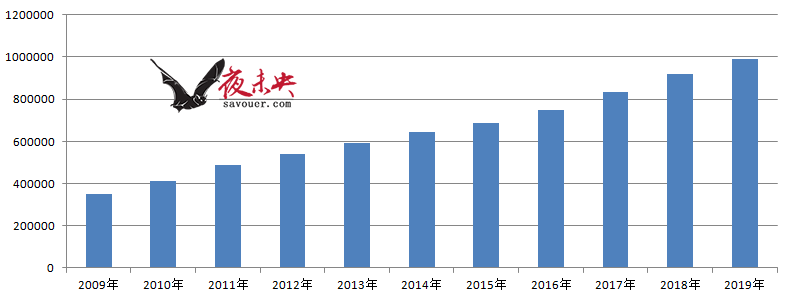
China’s annual GDP from 2009 to 2019 (100 million yuan)
In practice, the argument here is not that China’s GDP would actually turn negative in 2020, but that growth would slow. That would still leave total GDP above 2019. If inflation is set aside for a moment, and if the share of income within GDP is assumed to remain broadly stable, then per capita disposable income would also still be higher than in the previous year, even if its growth rate weakened.
Since GDP figures are generally discussed in real terms after removing inflation, positive GDP growth can be treated, in broad terms, as growth in income as well. By that logic, the issue in 2020 would not be falling income, but slower income growth.
The same reasoning can be extended beyond China. If countries such as the United States or other Western economies were hit hard by the pandemic and saw GDP fall by 5%, then under the same simplifying assumption, per capita income in 2020 would be roughly 95% of 2019 levels. Purely from a data standpoint, many of those economies would still remain above where they were in 2017. In the worst case, they would be rolling back only a few years.
If people in those countries were living comfortably in 2017, then a 5% decline from 2019 would not automatically mean a collapse in living standards in 2020.
Seen over a longer historical period, living standards and income are always relative. The size of income, the differences between countries, and the gaps between groups within a country are all comparative rather than absolute ideas.
Social instability is usually driven by inequality, not by a uniform decline
Historically, major social unrest has more often been triggered by horizontal inequality than by a general decline affecting everyone equally. In plain terms: people are less disturbed by having less than before than by seeing resources distributed unfairly.
This pattern can be seen repeatedly in Chinese history. Dynasties did not collapse simply because life became harder in the abstract, but because widening wealth gaps left the lower classes unable to survive, sharpening class conflict. At the beginning of a new dynasty, living conditions could in fact be even worse in absolute terms because of war and destruction. Yet the fall of the old elite often narrowed the gap in distribution, which made society more stable despite lower overall living standards.
A similar line of thinking can be applied to the American Civil War. It is commonly framed around slavery, but beneath that lay different economic systems and different patterns of income distribution. The North was built around modern manufacturing and a relatively more even distribution of wealth. The South was based on plantation agriculture and a social structure in which wealth was concentrated in the hands of slaveholders. In aggregate terms, southern elites held a large share of wealth, while average income in the South still lagged behind the North. That structural imbalance deepened social tensions within the South itself and sharpened the clash between the two regions.
Of course, human rights, religion, and international relations were also part of the Civil War’s causes. But the key point here is the distinction between broad decline and unequal distribution.
After unification, the United States saw major gains in overall income, especially in the 20th century, when per capita income remained among the world’s highest. Yet the country still experienced severe economic crises, especially the Great Depression of the 1930s and the major downturn of the 1970s, both of which brought obvious pressure on ordinary people. Even so, these crises did not produce major domestic political upheaval on the scale one might expect. One reason is that they were vertical shocks—a general deterioration—rather than purely horizontal redistributions favoring one group over another.
A pandemic does not automatically create mass unemployment
Another point often misunderstood is the relationship between a pandemic and unemployment. Pandemic control measures may force businesses to suspend operations, but suspended work is not the same thing as unemployment.
In economics, unemployment generally refers to people of working age who are willing and able to work for pay but have not found work.
Under pandemic conditions, many firms temporarily stop operating without formally laying off workers. Their employees are not necessarily unemployed in the strict sense. Even in sectors such as restaurants and construction, where many workers are temporary or flexible, a lack of work during an outbreak may in part resemble voluntary non-employment if workers choose not to work because of infection risk.
The article’s argument goes further: if work is available elsewhere, then some who are idle are not truly unemployed in the economic sense. A commonly cited example from that period was that while some restaurant and construction workers were not working, manufacturers such as Foxconn were still struggling to recruit and were reportedly even offering an additional 6,000 yuan allowance to attract labor. Under that logic, people who could take those jobs but chose not to would not be counted as involuntarily unemployed.
There are, of course, genuine layoffs caused by poor business conditions. Those cases are real. But the argument here is that their scale should not be exaggerated, and that many situations labeled as “unemployment” are in fact more complicated.
The distinction becomes clearer with the standard definition of voluntary unemployment: a worker remains unemployed because the wage or conditions available are below what they are willing to accept.
For example, suppose an employee at an IT company had been earning 30,000 yuan a month and was laid off when the company ran into trouble. If another firm then offered 15,000 yuan a month and the worker refused, that would fit the idea of voluntary unemployment rather than complete inability to find any job at all.
The minimum price of labor is the cost of basic family survival
That raises a practical question: where is the line between voluntary and involuntary unemployment?
One answer is to define it by the income required to maintain a family’s basic standard of living. That means more than just food and clothing. It should include ordinary spending on children’s education, support for elderly parents, and normal medical care. But the benchmark should be basic and reasonable public provision, not premium consumption—public compulsory schooling rather than elite private education, and ordinary insured medical care rather than luxury treatment.
Using that approach, a rough estimate offered here is that, excluding housing costs, 1,500 yuan per month per person would be enough in urban areas and 1,000 yuan in rural areas. For a family of five in a city, that implies monthly expenses of about 7,500 yuan. If there are two working adults, then around 3,750 yuan per worker per month becomes the dividing line between being unable to live on available wages and simply refusing current market conditions.
From this perspective, a pandemic by itself is unlikely to generate true mass unemployment in modern society. And a modest fall in income is not, by itself, enough to trigger major economic or social disorder.
Price increases deserve far more attention
Compared with concern over GDP, inflation often receives too little attention. Yet price data had already begun to show clear pressure.
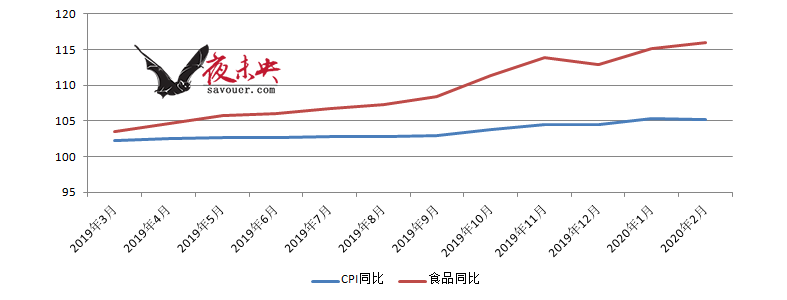
Year-on-year CPI from March 2019 to February 2020
Since October of the previous year, China’s CPI had risen noticeably, and by February it was up 5.2% year on year—an unusually high reading by recent standards. Food prices had surged even earlier: from September onward, food inflation stayed above 10% year on year for five consecutive months, reaching 16% in February.
At the same time, goods tied directly to epidemic control—masks, protective clothing, disinfectants—were all becoming more expensive. As the outbreak dragged on and production failed to return fully to normal, prices for grain, cooking oil, and everyday necessities also began to rise.
This was not just a domestic phenomenon. As outbreaks accelerated across Europe, the United States, much of Asia outside China, and parts of Africa, large-scale shutdowns spread globally. Under those conditions, elevated CPI readings around the world were easy to foresee. In some Western countries, the prices of pandemic-related goods reportedly rose more than tenfold, while many other daily necessities doubled or tripled, sharply increasing the cost of living.
Inflation can choke off consumption and damage the economic cycle
Rising prices produce two immediate effects: panic buying of essentials and weak sales of non-essentials.
People rush to buy necessities because they expect both higher inflation and tighter supply. Those two expectations reinforce each other. Once households begin stockpiling for safety, supply tightens further, which pushes prices up again.
At the same time, household income during a pandemic tends to weaken. When lower income meets higher prices, spending on non-essential goods is naturally cut back. That hurts the industries producing those goods and interferes with the normal circulation of the economy.
If the pandemic lasts long enough, non-essential sectors may shrink significantly. That can reduce employment, which then cuts consumption further and drags down total output.
Even more dangerous than CPI increases themselves is the expectation of further inflation. Once people believe prices will keep rising, they become more inclined to save and less willing to spend, which suppresses demand even more.
This is why many governments have tried to stimulate consumption through measures such as cash vouchers, tax reductions, or cuts in social insurance contributions. Various Chinese localities also issued consumption vouchers to support specific sectors more precisely.
During a pandemic, stabilizing prices and securing supply should come first
To prevent panic buying and excessive risk aversion, two things matter above all: stable prices and reliable supply. Only when both are present will consumption remain close to normal. And only normal consumption can support normal economic operation and, in turn, stable GDP growth.
China introduced a range of measures aimed at controlling prices. The most direct was the use of price caps. But administrative controls of that kind can distort normal market supply, so they can only be used selectively and on a limited scale.
In the end, price stability depends first on supply stability. If supply is adequate, prices are less likely to surge. And adequate supply requires businesses to resume work as fully as possible.
That brings the issue back to the central challenge: how to maintain production and supply while still controlling the epidemic. The view presented here is that China’s containment measures were relatively successful, which should help keep CPI more stable than in many other countries in 2020. Smaller countries, or countries with incomplete industrial chains, were likely to be hit harder and to experience sharper price increases.
Why inflation matters more than the headline growth rate
Modern economies depend on complex industrial division of labor. Different countries occupy different positions in global supply chains, and their outbreaks do not begin or end at the same time. That means final goods are constrained by disruptions across the entire chain. Some Western experts at the time even predicted that the pandemic could last until the following summer, making a clear rise in global CPI during 2020 highly likely.
If inflation is difficult to avoid, then the priority should not be obsessing over GDP growth rates. Even negative growth is not automatically the most dangerous outcome. A slower economy may not lead to the mass unemployment that some predict. But a sharp rise in CPI is far more threatening: it can distort industrial structure and push low-income groups into genuine hardship.
For that reason, the proper economic priority during a pandemic is first to stabilize CPI—especially the prices of goods tied to basic living needs—then to think about full employment, and only after that to focus on the total pace of GDP growth.
<sub>Note: China’s GDP was 83.2 trillion yuan in 2017 and 99.09 trillion yuan in 2019.</sub>