How Anime and Gaming Shaped Chinese Web Fiction
A claim has circulated for years that Fengzi Wuyu should be treated as the founding work of Chinese online fiction. That argument has always felt overstated. If the term is narrowed to early online xuanhuan fantasy, it is at least debatable. But once the entire field of web literature is brought into view, the claim becomes hard to defend. Chinese web fiction did not emerge from a single book or a single line of influence. It was shaped by traditional xianxia associated with figures like Huanzhu Louzhu, by Hong Kong and Taiwanese wuxia and romance, by imported fantasy and science fiction such as The Lord of the Rings and Dungeons & Dragons, and by Japanese anime and game culture. The earliest stage of genre formation in online fiction was full of imitation, hybridization, and experimentation.
Even some of the supposed evidence for giving Fengzi Wuyu a founding status does not hold up well. Its long length has been praised as if it established a new scale for online fiction, yet Chinese popular fiction had already produced massive works long before that. The Legend of the Swordsmen of the Mountains of Shu approached four million characters in the early twentieth century, and Huang Yi's Da Tang Shuang Long Zhuan had already reached four to five million characters before Fengzi Wuyu was finished in 2006. By the time that novel ended, many strong web novels had already appeared. Its influence was real, especially on early fantasy writers, but the heroic myth built around it often goes too far.
There is another complication. Fengzi Wuyu was, in essence, deeply shaped by fan-fiction logic. Its characters, role types, and settings drew heavily from Japanese anime, while its method of world-building borrowed from video games. If one follows that line of thought too far, the question almost asks itself: did Chinese web fiction come out of the two-dimensional world of anime and games?
The answer is still no—at least not in any simple or total sense. But the question is not meaningless. A serious case can be made that anime and game culture fundamentally altered the development of web fiction, and that some major online genres were born directly from that cultural sphere.
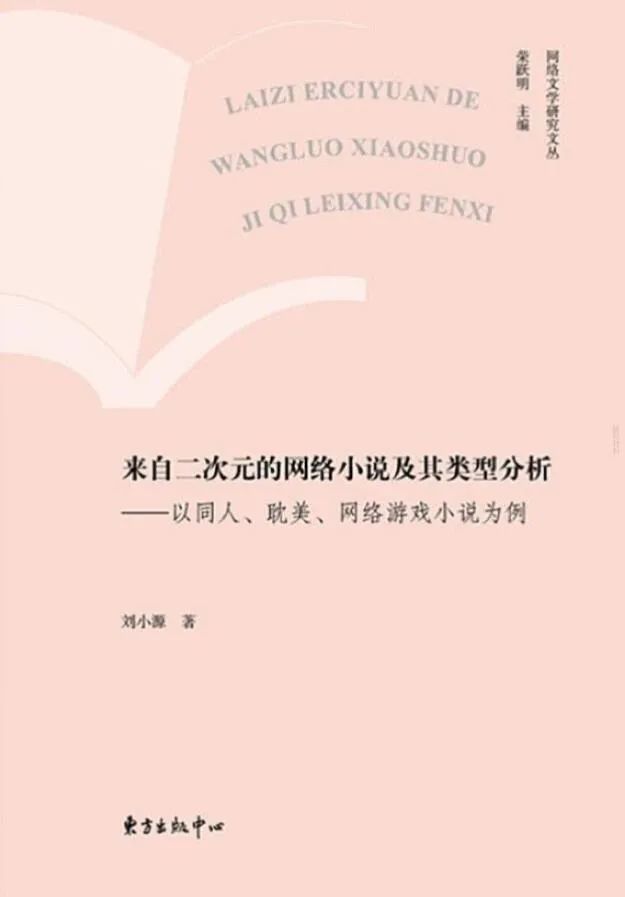
One of the more systematic summaries of this view appears in Liu Xiaoyuan's study of web fiction shaped by "2D culture," focusing on fan fiction, boys' love, and online game novels. Research on online literature has been changing in recent years. As readers who grew up with web fiction entered universities and became scholars themselves, academic discussion moved closer to the field it studies. Compared with the older, condescending critical posture often taken by literary institutions, newer work is more willing to treat online fiction on its own terms—including danmei, yuri, and even ABO writing. That shift matters. It means web fiction is no longer examined only from outside; it is increasingly being analyzed by people who are also part of its readership and cultural world.
What changed in online fiction
Web fiction today belongs overwhelmingly to grassroots culture. That helps explain why many veteran writers do not accept The First Intimate Contact as the "first" real web novel, even if it is often treated that way in cultural memory. Early online writers such as Pizi Cai and Ning Caishen still carried the temperament of elite intellectual culture. For them, the internet was a publishing channel. Their goals remained close to print literature in style, subject matter, and narration.
Contemporary web fiction operates very differently. It tends to move in a flat, direct line. It chases immediacy and payoff. Emotional stimulation often takes priority over cultural depth. According to this line of analysis, one reason for that transformation is the influence of anime and game culture, and that influence can be seen at three levels: content, logic, and language.
1. Content: anime and games expanded the supply of plots and genre formulas
"2D culture" became both a source of material and a laboratory of innovation for online fiction. Fan fiction, danmei, and online game novels merged with older popular genres such as wuxia and romance, producing countless newer fantasy forms. This is one reason genres such as transmigration-space stories and system novels could take shape so rapidly. They did not appear out of nowhere. They emerged from a broader environment in which readers were already comfortable with derivative worlds, character archetypes, power systems, and high-concept setups.
2. Narrative logic: game progression replaced realistic causality
Traditional fiction generally organizes itself around the logic of real life, even when the setting is fictional. By contrast, many web novels influenced by anime and games are structured according to the logic of gameplay. The clearest form of this is quantified power and linked spaces: level up, defeat stronger enemies, move to a new map, repeat. This framework has become so common that it is almost invisible to regular readers. Yet it marks a major shift in narrative construction. Instead of asking what would happen plausibly in a social world, these stories often ask what comes next in a progression system.
3. Language: prose became increasingly anime-like
The style of online fiction also changed. Narration became more cartooned and more performative. Mocking asides, inner monologue in the form of "OS," sudden authorial intrusion, and punchline-driven exchanges all became common. At the same time, detailed physical, psychological, and behavioral description often receded. In place of long descriptive passages, writers increasingly relied on compact labels that trigger preexisting reader recognition: "glasses girl," "scheming beauty," and other stock tags. The text does less work of building an image from scratch; instead, it activates a ready-made visual memory already shared by the audience.
Three web-fiction genres born directly from 2D culture
Liu Xiaoyuan's study does more than describe influence in general. It also tries to summarize the basic formulas of three major online genres that grew directly out of anime and game culture.
- Fan fiction:
fan fiction = original work + reader desire - Danmei:
danmei = male genitalia × (gong + shou) + romance narrative - Online game fiction:
online game fiction = gaming pleasure + gaming experience + genre narrative
Whether one agrees with these formulations or not, they point to something important: these genres are not simply branches of older literary categories. They arise from a media environment in which readers are already participants, modifiers, and reinterpreters of fictional worlds.
The argument goes further. Anime and game culture is no longer just a marginal subculture. It has been moving toward mass culture, and this process is likely to continue for at least the coming decade. On that basis, Liu argues that the central problem in the study of Chinese web literature is this: the discourse system of elite literary criticism cannot adequately deal with the discourse system imported through anime and game culture.
Why literary criticism has trouble with web fiction
Whatever one thinks of that conclusion, one reality is difficult to deny: mainstream literary criticism has largely lost the ability to intervene in the actual processes of web-fiction writing, circulation, and reading.
In practice, the old critical link in the chain is missing. Unless a web novel is being prepared for offline publication, neither editors nor critics matter very much to the relationship between writer and audience. Subscription numbers and ranking lists provide the real value signals that guide production. In an extreme sense, the interaction between author and readers online becomes part of the act of creation itself.
That does not mean, however, that literature has escaped ideological regulation. Even if editors and critics have been marginalized, the broader leadership of cultural production does not and cannot detach itself from the forces that regulate and direct ideology. On this point, the optimistic sense that web fiction has fully broken free from old systems seems doubtful.
How far the influence of 2D culture extends
Anime and game culture really has changed everyday life. Strictly speaking, identifying as part of "2D culture" usually means a taste for certain genres and a recognition of Japanese-style anime aesthetics. But the modes of expression associated with it—virtualization, cuteness, personification—have spread far beyond fandom. Since the generation born in the 1980s, content production, ways of thinking, values, and even life patterns have been profoundly shaped by it.
Someone may insist that they do not watch anime or play games, yet their everyday speech can still reveal the imprint of this culture. At the same time, what 2D culture ultimately represents is a spiritual orientation grounded in entertainment. As a youth subculture, it does not necessarily emphasize resistance. Very often, it does the opposite: it remains within existing norms and functions mainly as a mode of expression.
That point matters when discussing younger writers. One hopeful view holds that the generation born in the 1980s depends not on external salvation but on its own intelligence and ability, struggling through pain in order to live with dignity and value. Perhaps that is a generous ideal. For younger generations, traditional culture is still present, but online culture has often worked on them more deeply and more continuously. The virtual can occupy a larger space than the real. They move through networked environments with ease, while offline life may feel thin and impoverished. If so, then the direction of their literary creation will inevitably tilt toward that world.
At this point, it is already hard to separate the proportions of traditional culture and 2D culture in young people's writing. If this continues, we may end up somewhere close to the condition described by Joost Mool in The Odyssey of Cyberspace:
In the near future we may inhabit a hybrid space, living increasingly by the standards of virtual reality, and the distinction between fact and fiction may cease to be clear. Is that too bold a vision? In any case, Renaissance artists used fiction to reveal geographical space, while modern information technology allows us to dwell inside our own fictions. We are no longer using fiction to escape reality, but creating a heterogeneous reality. Perhaps the distinction between “fact” and “fiction” is already obsolete, and a better description would be a world of contending powers, because fiction has itself become reality. The disenchantment of space that occurred in modernity dialectically turns here into a kind of digital re-enchantment.
Notes on fandom, danmei, yuri, and ABO
Several observations from this line of research are especially useful for understanding how these genres developed.
Otaku culture in China never formed the same broad elite structure that it did in Japan. In today's usage, the word "zhai" has often been distorted into a label for a person who socializes mainly online, rarely leaves home, has no serious job, possesses a rich online life, and a poor real one.
The ABO setting originally came from a Supernatural fan work tied to Season 2, Episode 17. In that story world, werewolf society was structured around top-tier Alpha male and female wolves as leaders, with Beta male and female wolves as the supporting leadership, while Omega represented the lowest rank, usually with only one wolf in that position. From Alpha, Beta, and Omega came the now-famous ABO shorthand, which then developed into a wholly new world-setting in which everyone possesses a dual-sex constitution. It eventually became one of the most distinctive subgenres inside online danmei fiction.
Many famous works with independent status began as fan fiction. Once they became bestsellers, the original online versions were often deleted by their authors and became difficult to trace. There are many such examples. The work commonly called a "danmei textbook," Minami Ozaki's Zetsuai, began as a short Captain Tsubasa fan story. The once hugely popular Poor Prince also came out of short-form Slam Dunk fan fiction.
When discussing danmei, three issues cannot be avoided: love, sex, and gender.
Even after establishing an ABO framework with six nominal genders, mainstream ABO storytelling often still reveals the old binary structure underneath: romance leads to marriage, marriage to childbirth, childbirth to reproduction of the group. In that sense, online danmei fiction continues to waver between secular romance conventions and the aspiration toward gender equality.
Danmei itself grew out of shoujo manga and reflects the currents of female independence and liberation that developed from the 1970s onward. It can be understood as a variant of romance fiction. Between 2006 and 2016, the CNKI database indexed 1,776 research papers involving danmei fiction, including 23 master's theses and 1 doctoral dissertation. Most of this scholarship was produced by participants in danmei culture themselves, typically young female scholars born from the late 1970s to the early 1990s. Yet much of this work rarely engages closely with literary texts. It tends to offer examples of danmei's "aesthetic" language and only a very small amount of sexual description, while lacking sustained textual analysis. That imbalance is also related to the fact that many researchers of danmei culture come from sociology, anthropology, and communication studies rather than literary studies.
Yuri has followed a different route. Unlike danmei, it does not place the same emphasis on idealized beautiful love. Although the concept also came from Japan, its spread in China's online world was quite different. Male readers and male creators came first, and the genre initially served the erotic curiosity of men more than any discussion of love; it was a release of desire rather than an exploration of relationships. This only began to change when yuri fiction developed inside female-oriented online fiction spaces. Even now, despite also dealing with same-sex themes, yuri still lacks a single stable and precise definition.
What all of this suggests is not that web fiction can be reduced to anime, games, or fandom, nor that traditional culture has disappeared. Rather, the field has become so mixed that old literary categories alone can no longer explain it. Youth subculture is not always rebellious. Often it simply offers a freely chosen style of expression. But when that style saturates plot design, character coding, reading habits, and even everyday language, it stops being a minor aesthetic preference and becomes part of the grammar of contemporary culture itself.