Planning for F.I.R.E., Starting With the Life I Actually Want
A few years ago, I talked with friends about retiring early. At the time, we were not using phrases like “financial independence.” The idea was much rougher: save enough money, spend carefully, and leave work early enough to live like a normal person. In the internet industry, the workload is intense enough to ruin your health, and the fear of sudden death is not exactly abstract.
F.I.R.E. — financial independence, retire early — has become popular in recent years, but the question of how much money is “enough” remains controversial. Some people think F.I.R.E. is as vague as “middle class”: useful in conversation, but hard to define. One person may say 3 million is enough; another may feel that even 5 million cannot buy a decent apartment. There is no universal benchmark. In the end, “enough” is personal.
For me, early retirement does not mean never working again. It means covering basic living expenses through passive income, no longer chasing work out of pressure, and having time for the things I actually care about: reading, writing, or joining interesting projects that may not pay much. After reading a few books on personal finance and following several well-known investors into different products this year — with both gains and losses — I have started to form some of my own views. So I decided to record my plans and experiments from here onward.
What kind of life am I trying to buy?
There is no shortage of detailed F.I.R.E. plans online, both in China and abroad. Public accounts that discuss money, Reddit communities such as financialindependence, and many long-running personal blogs all provide useful references. But it is better to study broadly and then design a strategy around your own needs. Copying someone else’s plan mechanically, or following the crowd blindly, is dangerous.
I prefer to start with the actual need. So the first question is: after reaching F.I.R.E., what life do I want to live? This determines both the starting line and the finish line.
In terms of material expectations, my ideal life is not extravagant:
- I do not have big career ambitions. I want enough time to do what I enjoy, such as reading, writing, or working on low-paying but interesting projects.
- I want comfort, not wealth for its own sake. As I get older, material desire is not as addictive as it once was. If I occasionally hesitate over a digital gadget, I hope the price is ordinary enough that I can buy it without much trouble. Even if I suddenly want to play around with something, I should be able to afford that impulse.
- I am not obsessed with living in a home I own, but the living space should be comfortable and not cramped. I am also not attached to owning a car.
Overall, I am not someone with very high requirements for lifestyle quality. Food, clothing, and daily use can all be adjusted according to ability. Thinking carefully, my current life is not actually that far from the ideal one — except that I still have to work a regular nine-to-five job every day. My current annual net spending, excluding education, insurance, and support for parents, is around 150,000 yuan.
A rough target calculation
Once the ideal life is clearer, the next step is setting a personal F.I.R.E. target. To begin with, consider normal retirement. Given the general social trend, retiring at 65 is basically the base case. Average life expectancy is also increasing, so it is conservative to assume another 30 years of life after retirement.
Using personal monthly spending of 15,000 yuan, annual spending would be 180,000 yuan. This estimate includes daily living, shopping, travel, and medical expenses.
This calculation does not include rent, pension payments, social security, or serious illness insurance. In theory, if those are properly arranged, they should provide additional buffer for daily expenses. Children are not included either — if you are raising children, can you still talk about F.I.R.E.? That is a separate joke. A partner is also not included; with a good partner and two people working together, the difficulty may actually decrease.
Assumptions:
- Savings at age 65: 3 million yuan
- Annual spending: 180,000 yuan
- Annual inflation: 5%
- Average investment return: 10%
The calculation logic is:
- Remaining savings = savings - annual spending
- Investment return = remaining principal × investment return rate
- Ending balance = remaining savings + investment return

Based on this model, if retirement begins at 65 with 3 million yuan in savings, the money should be almost exactly used up by age 95. Keeping the same assumptions but moving retirement earlier to 35, 40, and 45, the required retirement savings to last until 95 would be about 3.72 million, 3.65 million, and 3.6 million yuan respectively.
At first glance, the starting amounts do not look dramatically different. But because the starting age changes, the actual difficulty increases a lot.
Of course, this is only an idealized forecast. It does not include unexpected risks, and both inflation and investment return are handled in a simplified way. Annual spending is also uncertain. My current spending, even without being especially frugal, does not reach 180,000 yuan a year. But from now to age 65, there is decades of inflation to consider. For now, there is no need to perfect every assumption. It is better to use this as a working target and adjust during practice.
A first target should have some ambition. It is better to set it slightly higher. If you are in your twenties, challenging the age-35 version may be worth considering.
Where the money can come from
After setting a target, the next question is how to accumulate the funds needed to reach it. The main factors to look at are current assets, income, annual spending, and the intended timeline. The timeline is closely tied to income. The biggest problem in personal finance is often not return rate, but lack of principal. Someone earning 100,000 yuan a year will have a very hard time accumulating 10 million yuan in 10 years, no matter how good their “financial management” sounds.
A personal financial inventory should include:
- cash-flow assets
- fixed assets
- annual income, including active and passive income
- annual spending
Suppose the personal target is 4 million yuan and current assets are 500,000 yuan. For forecasting, an investment calculator is useful.
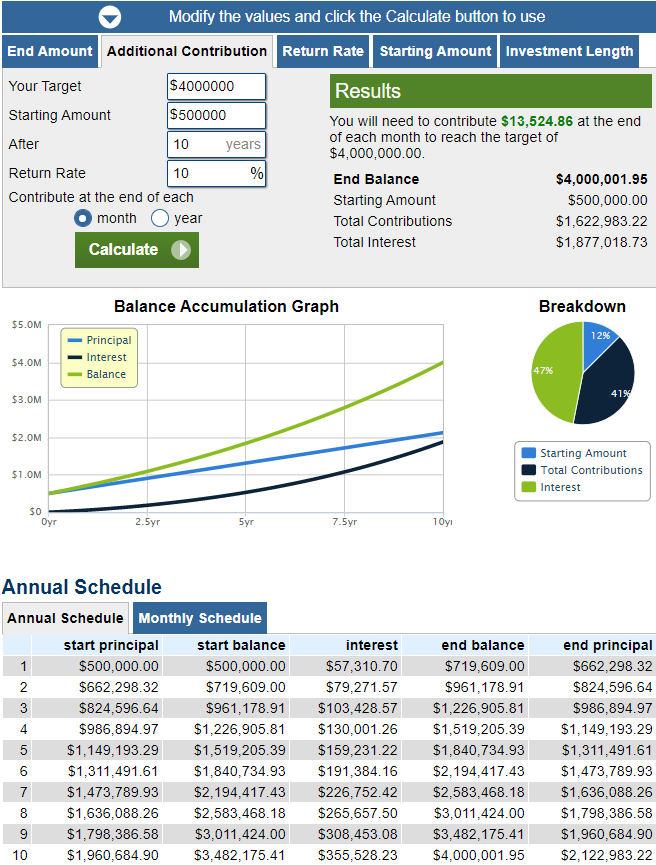
The forecast shows that I would need to save — or add into the investment pool — 13,525 yuan per month, while maintaining an average annualized investment return of 10%. Based on current income, the monthly contribution is still achievable. For now, this also temporarily ignores the possibility that income may drop sharply after age 40. The more difficult part is whether a 10% annualized return can be maintained, which requires careful study of investment strategy.
Logically, the investment strategy before and after F.I.R.E. should not be the same. Before reaching the target, the approach may need to be more aggressive, aiming for 15% annualized return or even higher when possible. After reaching the target, because the main goal becomes long-term living expenses and retirement security, more stable assets should take a larger share; a 6% return would be more suitable. For now, I will plan around 10% and revise after actual practice.
Rebuilding the investment structure
As of December 2020, looking at my investments from 2019 onward, I have not actually achieved a 10% annualized return. I also feel the current allocation needs adjustment. The share of individual stocks is too high. On one hand, managing them takes too much energy; on the other, it is not helpful for maintaining emotional stability. The allocation to actively managed funds and more stable assets should increase. The first priority is to make money with less constant effort.
My adjustment plan for 2021 is to continue holding existing individual stock positions that already have gains, but stop using new capital to buy stocks. New money will go into other types of investment products.

Besides adjusting proportions, I also need to spend more time building my own investment framework. At present, my main strategy is still to follow well-known investors — in other words, I assume their financial ability is better than mine. But that cannot replace learning. I still need a deeper understanding of different investment products, otherwise I may step into traps without even realizing it.
What can be changed besides investing?
Apart from investment income and salary income, the two things I can still do for F.I.R.E. are reducing expenses and increasing other income. It sounds obvious, but it is also genuinely the most effective path.
In the long run, the biggest reduction in annual spending may come from moving from a first-tier city to a second-tier city. However, considering overall living experience, I would not recommend going to a third-tier city or below. For now, this mainly affects the choice of a future retirement city.
I firmly oppose saving money by lowering quality of life. In reality, personal consumption usually has much more room for optimization than we imagine. Previously, transfers, splitting bills, and AA reimbursements made my accounts messy. Starting in December, I tried an expense-only accounting method: I record only actual consumption. This makes it much clearer how much I really spend each month.

The table shows that even with taxi rides, eating out, and shopping, it is not impossible to keep monthly spending around 4,000 to 5,000 yuan. Expenses such as personal development, medical insurance, and support for parents are difficult to avoid, but they can be averaged more reasonably across months.
So my 2021 consumption budget is set at 6,000 yuan per month. If larger expenses are spread out monthly, the total should not exceed the budget.
Cost control alone is not enough. Passive income or part-time income also needs to increase. Some people sell pixel-style emoji packs online. Some sell photos to stock image platforms. Some earn pocket money by writing novels or articles. People who play games can try streaming. In short, it is necessary to find ways to turn skills into extra income, ideally by monetizing interests.
For myself, in 2021 I am considering earning some writing fees and making use of previous connections to see whether there are extra projects I can do. The hope is to raise part-time income to about 10% of salary income.
Keeping track without letting the goal become a burden
This is the first record of the plan. Later, I may track asset allocation monthly or quarterly, include monthly expenses in the record, and use the data to follow progress toward the target. If possible, I will also review investment changes once a year and decide whether the target needs adjustment.
The goal looks difficult, but there is no real downside to trying step by step. One thing is worth remembering: F.I.R.E. is meant to free people from financial pressure and help them pursue a better life. If failing to reach a F.I.R.E. target becomes a source of anxiety, then the whole thing has turned upside down.