Why I Keep Checking In on My Frog in Travel Frog
This is not a strategy guide. Really, it isn’t. I have no interest in writing a proper walkthrough.
I’m talking about the recently popular mobile game Travel Frog, not actual frog care. Since I can’t read Japanese, I can’t even type the game’s original title properly, so I’ll just stick with the name everyone uses. I didn’t start playing because of any “zen” trend people like to attach to it. I just thought it was fun. It doesn’t demand much energy, it doesn’t take much time, and you can simply open it whenever it crosses your mind.
This is my little frog at home. There’s this moment where it munches away with its mouth wide open, and somehow that’s absurdly hard to capture in a screenshot.
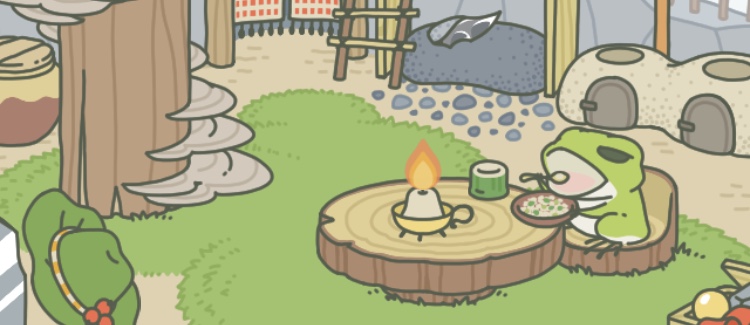
Because the original version is in Japanese, you have to feel your way through the menus and figure out how everything works on your own. Thankfully, it’s not especially complicated. There is also a Chinese-localized version available online, mainly for Android, and jailbroken iPhones can get it too. Honestly, if someone really can’t figure out how to play, there are already plenty of explanations floating around on forums and social platforms. What I kept needing in everyday play was a sense of what all the shop items actually do, so here’s a rough summary of the item notes I’ve seen people share online.
What the shop items seem to do
- Grape Scone (10 clovers): the simplest and cheapest meal; the frog still seems a little hungry after eating it, and it’s likely to head out soon.
- Sandwich (20 clovers): basically fast food.
- Pumpkin Bagel (50 clovers): a hearty meal; good for long trips, and the frog may stay away for quite a while.
- Omelet (80 clovers): after eating it, the frog tends to come home sooner.
- Mugwort Bun (100 clovers): good for hot places; helps with the heat.
- Spring Onion Bun (100 clovers): better for cold places; helps keep warm.
- Lucky Bell (3000 clovers): a reusable lucky charm that’s supposed to help the frog return home safely.
- Different wrapping cloths: these show up in the photos the frog mails back.
- Different tents: the pricier the tent, the fancier it is, and the less eager the frog seems to be to come back. They appear in camping photos.
- Different bowls: the frog can use them while crossing water, and you’ll spot them in travel photos.
- Different lamps: these show up in adventure photos.
I’m starting to think I spent too long buying only the cheapest food, because my frog is constantly leaving the house. It goes out early, comes back late, stays home for only a few hours, and then disappears again. Half the time I wake up in the middle of the night and find it at home, then by morning it has already gone traveling again. It’s somehow more diligent than I am.
And saving up clovers really is slow. Everything in the shop costs more than you want it to. It’s the kind of game clearly designed to keep people playing for a long time, one small purchase at a time.
My frog also doesn’t bring back local specialties very often, but that snail keeps visiting all the time. I never seem to have extra souvenirs to give it, which makes me feel weirdly guilty every single time.
Honestly, the more I stare at that tiny little house my frog lives in, the more I think it might be a pretty fun place to live myself.